


1746-OA8 vs 1746-OA16 : nombre de sorties et limites de courant
Une comparaison directe du nombre de sorties, du regroupement commun, du courant du fond de panier et des limites de charge avec déclassement thermique de 1746-OA8 et 1746-OA16.
Fabricant : Omron
N° de produit : E3Z-LL81
Pays d'origine :Japon
Type de produit : Capteurs photoélectriques
Paiement : Virement bancaire, Western Union
Poids : 1000g
Dimensions : 150 x 100 x 50 mm
Port d'expédition : Xiamen
Garantie : 12 mois
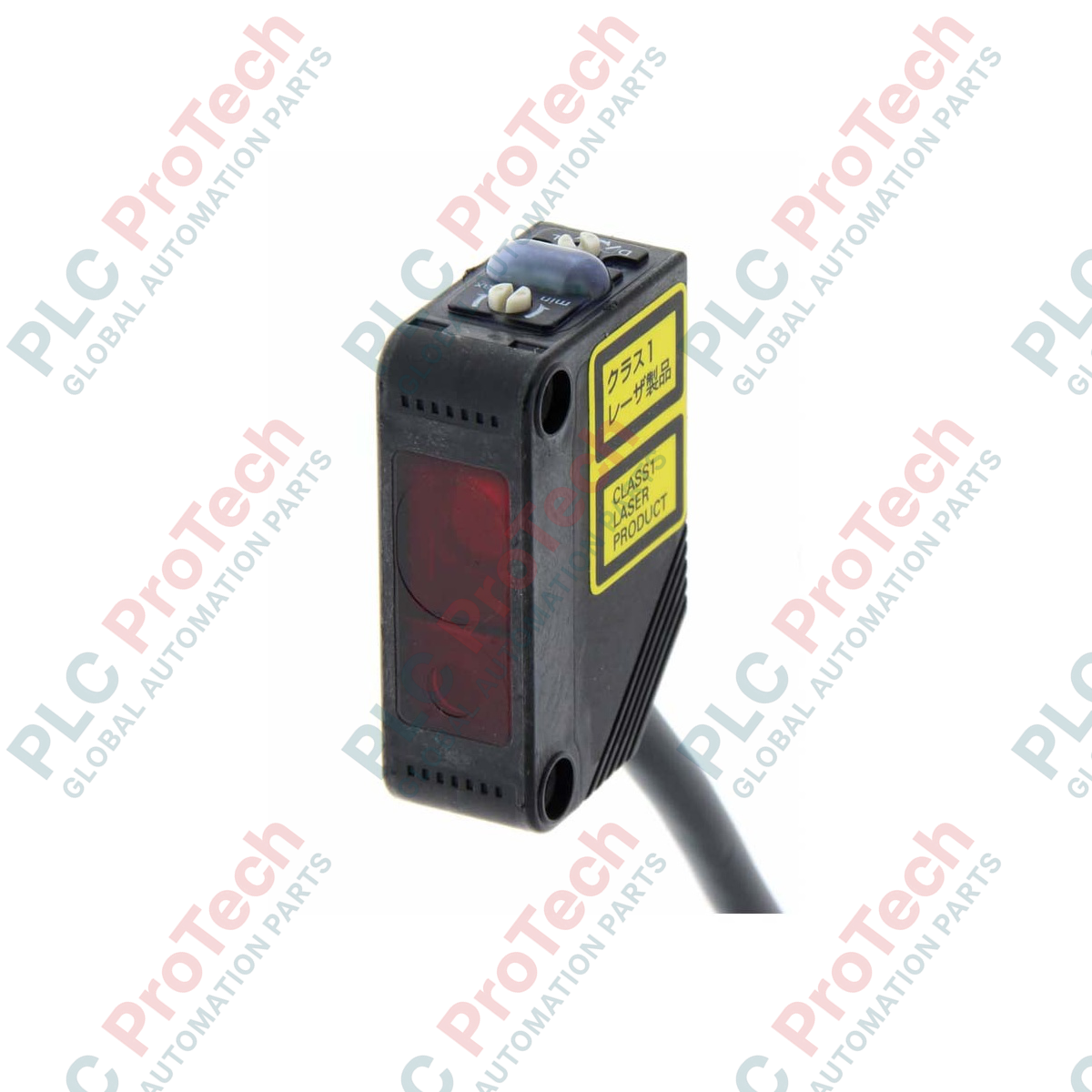
Assurant une suppression précise de l’arrière-plan (BGS) avec distance réglable dans les configurations de positionnement complexes, le capteur photoélectrique Omron E3Z-LL81 utilise une diode laser rouge de classe 1 haute précision pour détecter les cibles au millimètre près. Ce capteur est conçu pour ignorer les objets d’arrière-plan situés au-delà de la limite de coupure définie, offrant une détection très fiable des objets quelle que soit leur couleur, leur brillance ou leur angle. Avec son spot de 0,5 mm de diamètre ultra-concentré à 300 mm, l’appareil est idéal pour la vérification de composants électroniques, la détection de petites pièces et les machines d’emballage automatisées à grande vitesse.
| Paramètre | Spécification |
|---|---|
| Fabricant | Omron |
| Référence du modèle | E3Z-LL81 |
| Méthode de détection | Distance réglable (modèles BGS) |
| Distance de détection (papier blanc) | 20 à 300 mm (cible de 100 x 100 mm) |
| Distance de détection (papier noir) | 20 à 160 mm (cible de 100 x 100 mm) |
| Plage de distance de réglage (papier blanc) | 40 à 300 mm |
| Plage de distance de réglage (papier noir) | 40 à 160 mm |
| Source lumineuse (longueur d’onde) | LD rouge (655 nm), classe 1 JIS, classe 1 CEI, classe 2 FDA |
| Diamètre du spot (valeur de référence) | Diamètre de 0,5 mm à 300 mm |
| Tension d’alimentation | 12 à 24 VCC +/-10 %, ondulation (crête à crête) : 10 % max. |
| Consommation de courant | 30 mA max. |
| Sortie de commande | Collecteur ouvert PNP, 26,4 VCC max., courant de charge de 100 mA max. |
| Poids d’expédition (calculé) | 1,00 kg (emballage d’usine protecteur inclus) |
| Dimensions de l’emballage (calculées) | 150 x 100 x 50 mm |
| Couleur des fils | Fonction / affectation |
|---|---|
| Marron | Alimentation (+V, 12 à 24 VCC) |
| Bleu | Alimentation (0 V / GND) |
| Noir | Sortie de commande (collecteur ouvert PNP) |
| Rose | Entrée de commande (sélection Light-ON / Dark-ON) |
Le modèle E3Z-LL81 dispose d’une sortie à collecteur ouvert PNP. Si votre système de commande nécessite une configuration NPN, utilisez le modèle alternatif E3Z-LL61. Les dimensions de montage et les plages de détection sont identiques pour les deux modèles, ce qui permet un remplacement physique direct lors de l’intégration au système ou de la modification de la logique.
Lors de l’installation du capteur dans des environnements comportant du métal très réfléchissant ou des arrière-plans miroirs proches du champ de détection, les réflexions de l’arrière-plan peuvent contourner la coupure BGS. Pour neutraliser ce retour optique, montez le capteur selon un angle de 5 à 10 degrés par rapport à la surface de la cible. Évitez de placer le capteur en plein soleil ou face à de puissantes sources lumineuses à décharge haute fréquence, qui peuvent perturber le circuit récepteur.
Pour configurer le mode de sortie du capteur, utilisez le fil de commande rose intégré. Le raccordement du fil rose au fil marron (+V) configure le capteur en mode Dark-ON, tandis que son raccordement au fil bleu (0 V) ou son maintien en circuit ouvert le configure en mode Light-ON. Vérifiez les limites de courant avant le raccordement afin d’éviter d’endommager le transistor PNP interne par surintensité.
Débranchez toutes les sources de distribution électrique avant d’effectuer des raccordements électriques ou des réglages mécaniques. Ne regardez pas directement dans la lentille de l’émetteur laser lorsque le capteur est sous tension, car une exposition directe au laser peut provoquer une irritation oculaire ou des lésions optiques.
Fixez solidement le capteur à l’aide d’une équerre Omron en L compatible ou directement sur le châssis de la machine, en veillant à ce que le trajet optique vers la cible soit exempt de tout obstacle physique.
Câblez le capteur conformément au schéma électrique. Assurez-vous que le fil rose est raccordé au potentiel approprié (+V ou 0 V) afin de définir le mode de fonctionnement requis (Light-ON ou Dark-ON).
Appliquez une alimentation de 12 à 24 VCC et vérifiez que l’indicateur vert de stabilité reste allumé en l’absence de détection, indiquant une marge de signal suffisante.
Placez l’objet cible à la distance de détection maximale souhaitée, puis réglez la vis intégrée de réglage de distance multitours jusqu’à ce que l’indicateur orange de fonctionnement s’allume.

Livraison express mondiale
Retours et garantie
Expédition express mondiale
Retours et garantie
Les commandes sont traitées et livrées du lundi au vendredi (hors jours fériés).
Pour connaître l'éligibilité complète, les frais de restockage et les détails des retours internationaux, veuillez consulter notre site officiel Politique de remboursement et de retour .
| Country of origin |
Japon
|

Une comparaison directe du nombre de sorties, du regroupement commun, du courant du fond de panier et des limites de charge avec déclassement thermique de 1746-OA8 et 1746-OA16.

Une liste de contrôle sur le terrain pour consigner la série matérielle 1761-NET-DNI, le firmware, le fichier EDS, les paramètres DF1, l’adresse DeviceNet et la configuration de messagerie avant le...

L’EL3062 est un terminal EtherCAT 0–10 V. L’EL3062-0030 est une variante 0–30 V. Cette liste de contrôle couvre l’identification, la mise à l’échelle et la mise en service.

Une liste de contrôle sur le terrain pour remplacer les modules de sortie à relais Allen-Bradley 1769-OW8 sans perdre les informations relatives aux groupes de charges, au câblage et à la mise en...

Une liste de contrôle sur site pour faire correspondre les E/S numériques et analogiques des automates programmables aux capteurs, charges, communs, groupes d’isolation, filtres et paramètres de...

Une liste de contrôle axée sur le terrain pour sélectionner, installer, mettre en service et diagnostiquer les débitmètres électromagnétiques, en mettant l’accent sur la conductivité, les conditions...