1 de 1

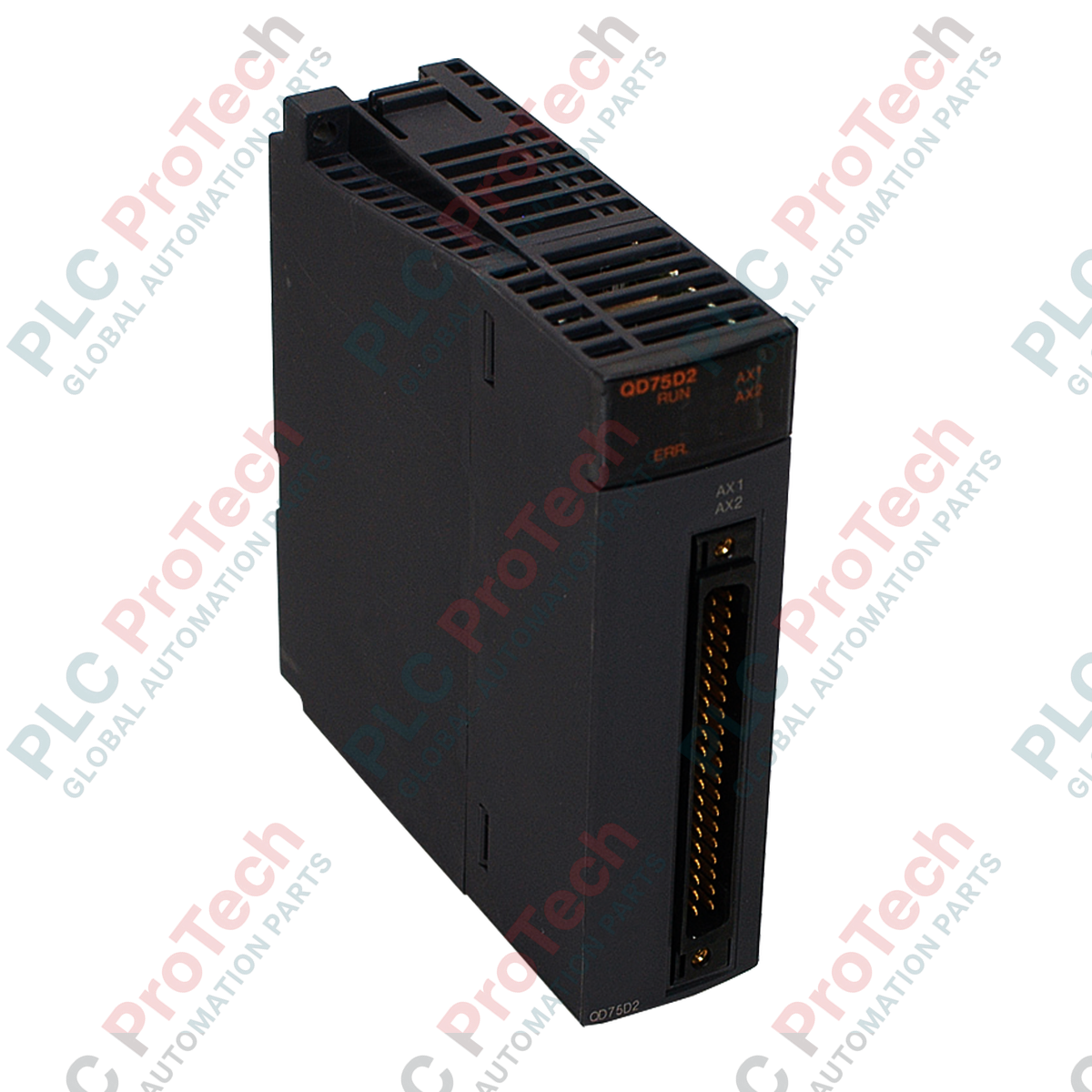
QD75D2 | Mitsubishi Module de Contrôle de Position à Sortie Impulsion Deux Axes

QD75D2 | Mitsubishi Module de Contrôle de Position à Sortie Impulsion Deux Axes

Il ne reste que 10 article(s) en stock
  • Fabricant : Mitsubishi Electric

  • N° de produit : QD75D2

  • Pays d'origine :États-Unis

  • Type de produit : PLC Positioning Modules

  • Paiement : Virement bancaire, Western Union

  • Poids : 1000g

  • Port d'expédition : Xiamen

  • Garantie : 12 mois

Quantité
Voir les détails complets

For precise multi-axis motion control within the MELSEC Q Series architecture, the Mitsubishi Electric QD75D2 provides high-speed differential driver pulse train outputs for up to two independent axes. This high-performance positioning module enables seamless integration of point-to-point, speed-position, and interpolated path control directly from the PLC backplane to high-resolution servo drives.

Key Features

  • Two-Axis Control: Supports independent or simultaneous control of up to two axes.
  • Advanced Interpolation: Executes 2-axis linear interpolation and 2-axis circular interpolation for complex path profiles.
  • High-Speed Differential Output: Line driver outputs support pulse rates up to 1 Mpps, enabling high-resolution positioning over longer distances.
  • Battery-Less Backup: Parameters, positioning data, and block start data are stored directly in non-volatile Flash ROM.
  • Multi-Unit Support: Configurable command units including millimeters, inches, degrees, and pulses.
  • Extensive Data Storage: Stores up to 600 positioning data points per axis, configurable via engineering software or ladder logic.

Industrial Applications

  • High-speed packaging, cartoning, and sealing machinery.
  • Multi-axis Cartesian coordinate gantry systems and pick-and-place robots.
  • Precision semiconductor handling, wafer alignment, and positioning tables.
  • Automated storage and retrieval systems (ASRS) and material handling transfer cars.

Technical Specifications

Parameter Specification Value
Manufacturer Mitsubishi Electric
Model Number QD75D2
Control Axes 2 axes
Output Type Differential driver (Line driver)
Max. Output Pulse Rate 1 Mpps
Max. Connection Distance 10 meters
Interpolation Functions 2-axis linear interpolation, 2-axis circular interpolation
Control Modes PTP (Point To Point), Path control, Speed control, Speed-position switching, Position-speed switching
Positioning Data Points 600 data points per axis (Nos. 1 to 600)
Backup Memory Flash ROM (Max. 100,000 write cycles)
Internal Current Consumption 0.56 A (at 5V DC)
Occupied I/O Points 32 points (Intelligent function module assignment)
External Interface Connectors A6CON1, A6CON2, A6CON4 (sold separately)
Applicable Wire Size 0.3 mm2 (A6CON1/A6CON4), AWG 24 (A6CON2)
Country of Origin Japan
Shipping Weight (Calculated) 1.00 kg

Empirical Engineering Insights

Alternative Models & Compatibility

The QD75D2 features differential line driver outputs, distinguishing it from the open-collector QD75P2. While the QD75P2 is limited to a 200 kpps output rate and a 2-meter physical cable run, the QD75D2 supports up to 1 Mpps and a 10-meter connection distance. If you are upgrading from a P-series to a D-series module, you must replace the external cabling and verify that the command pulse input of your servo amplifier is configured to receive differential line receiver signals.

Application Pitfalls & Engineering Notes

When operating in "degree" control mode, ensure that the software configuration accounts for the axis rotation limits. If the axis is set to endless rotation, proper handling of the overflow/underflow boundary is required in the PLC logic to prevent unexpected positioning jumps. Additionally, write operations to the Flash ROM must be managed carefully; do not exceed the 100,000-cycle limit by executing automated writes within cyclic execution blocks.

Commissioning & Wiring Tips

Always use shielded twisted-pair cabling for the pulse output lines to mitigate electromagnetic interference (EMI). The shield should be grounded at the control panel entry point. When wiring the A6CON1 or A6CON4 connectors, ensure the wire gauge is exactly 0.3 mm2 to guarantee robust physical terminal retention and prevent intermittent signal loss under cabinet vibration.

Installation Guidelines

CRITICAL WARNING:

Before installing, removing, or wiring the QD75D2 module, ensure that the main power supply to the PLC rack and all external power sources for the servo amplifiers are completely de-energized. Failure to do so may result in electric shock, module damage, or unintended machine movement.

1

Align the module's bottom retaining latch with the slot on the Q-series base unit, then push the module firmly into the backplane connector.

2

Secure the module to the base unit using the top fixing screw (tighten to the torque specified in the manual, typically 0.36 to 0.48 N·m).

3

Connect the pre-wired A6CON1, A6CON2, or A6CON4 external connector to the front interface of the module, ensuring the connector lock mechanism is fully engaged.

4

Power up the PLC rack, verify that the "RUN" LED on the module illuminates, and use GX Works to perform initial parameter configuration and test runs.

Loading product navigation…

What is the main difference between the QD75D2 and the QD75P2?

The QD75D2 features differential line driver outputs supporting up to 1 Mpps and a 10-meter transmission distance, whereas the QD75P2 uses open-collector outputs limited to 200 kpps and a 2-meter distance.

Does the QD75D2 require a backup battery for positioning data?

No. Parameters, positioning data, and block start data are saved directly to internal Flash ROM, providing battery-less backup.

What external connectors are compatible with the QD75D2?

It is compatible with A6CON1, A6CON2, and A6CON4 connectors, which must be purchased separately.

How many occupied I/O points does this module require on the Q-series rack?

The module occupies 32 I/O points, which must be assigned as an intelligent function module in the GX Works configuration.

Expédition express mondiale

  • Livraison standard : 4 à 6 jours ouvrables via DHL, FedEx et UPS.
  • Expédition express : Expédition le jour même pour les commandes en stock passées avant 14h00 (GMT+8).
  • Couverture mondiale : Service dans plus de 150 pays, avec livraison rapide en Arabie Saoudite et aux Émirats arabes unis.

Retours et garantie

  • Garantie de 30 jours : Retours acceptés pour les produits en stock dans leur emballage d’origine scellé en usine.
  • Garantie de 12 mois : Chaque composant industriel est couvert par notre garantie technique professionnelle.

Les commandes sont traitées et livrées du lundi au vendredi (hors jours fériés).


Pour connaître les conditions d’éligibilité complètes, les frais de restockage et les détails des retours internationaux, veuillez consulter notre site officiel Politique de remboursement et de retour .

TECHNICAL SPECIFICATIONS

Country of origin
États-Unis

Produits récemment consultés

Connaissances techniques

Logique booléenne en programmation PLC : comprendre les portes logiques FBD

La logique booléenne est la base de tout programme PLC. Des commandes machines simples aux systèmes d'automatisation industrielle complexes, les portes logiques déterminent comment les contrôleurs...

Guide approfondi sur les pare-feux industriels et la segmentation des réseaux OT

Les pare-feux industriels jouent un rôle crucial dans la cybersécurité OT, protégeant les réseaux PLC, DCS et SCADA grâce à la segmentation, au contrôle des entrées/sorties et à l'intégration IDS/IPS...

Guide des préhenseurs robotiques : de la manipulation délicate à l'automatisation lourde

Les pinces robotiques modernes évoluent au-delà des mâchoires mécaniques traditionnelles. Des systèmes adhésifs inspirés du gecko et des pinces souples de qualité alimentaire aux outils d'entrepôt...

Retour en arrière : comment les premiers moteurs électriques ont transformé l'exploitation minière souterraine

Des compresseurs à courant continu entraînés par corde aux wagonnets de mine alimentés par batterie, les premières opérations minières ont marqué un tournant dans l’électrification industrielle. Cet...

Factory I/O : un outil moderne de simulation PLC pour la formation à l'automatisation industrielle

Factory I/O révolutionne l'enseignement des automates programmables industriels (API) en proposant des simulations industrielles 3D immersives pour les étudiants, les ingénieurs et les équipes de...

Programmation des cycles de mouvement à axe unique sur un servo-variateur CMZ

Ce tutoriel examine comment la fonctionnalité PLC intégrée dans un servo-variateur CMZ SBD peut exécuter des programmes de mouvement autonomes, y compris la logique de référencement, le contrôle de...