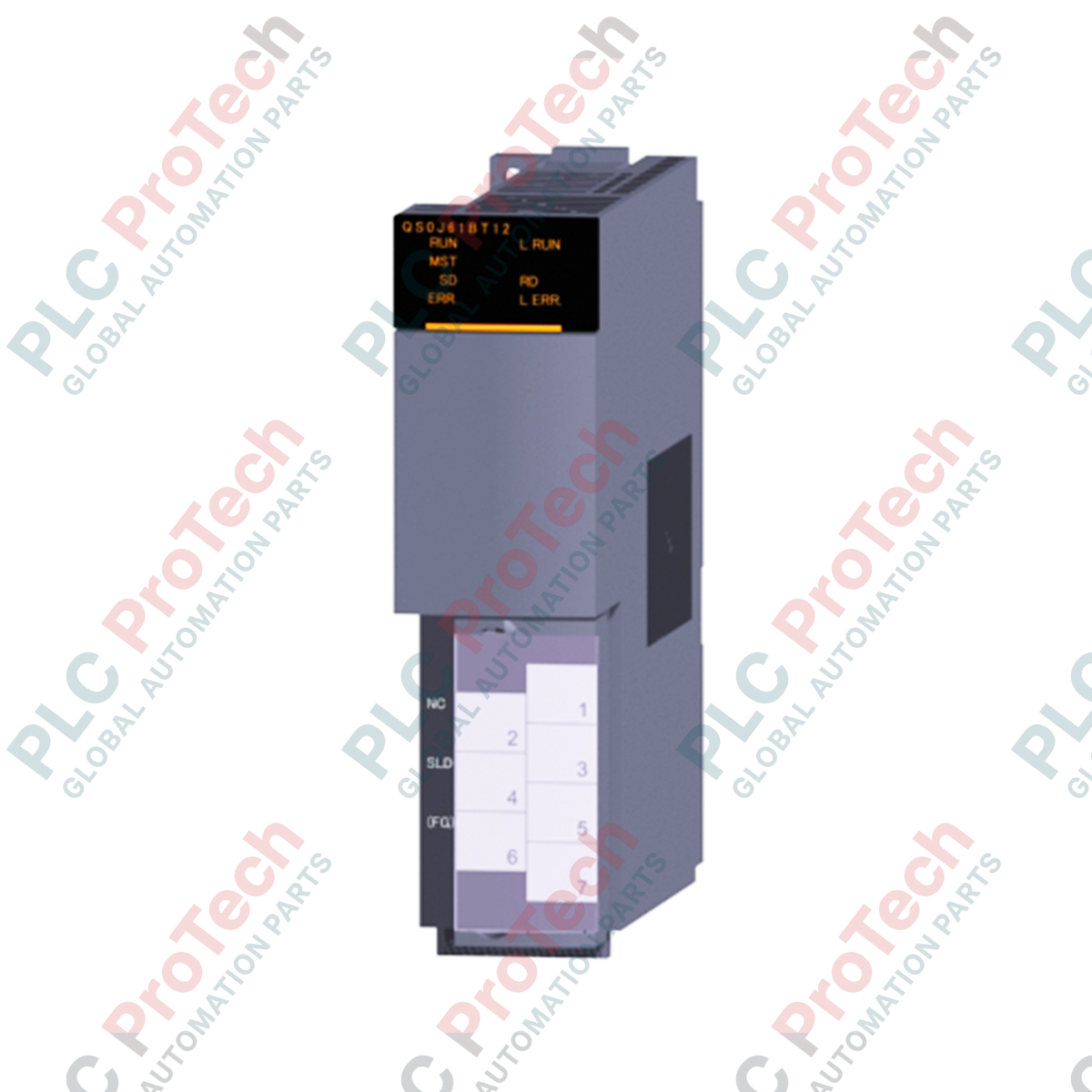
Description
Assurant une communication déterministe et fonctionnellement sûre dans les environnements à haut risque, le Mitsubishi Electric QS0J61BT12 est une station maître CC-Link Safety dédiée aux plateformes de commande MELSEC-QS. Ce module maître de sécurité coordonne les stations d’E/S distantes sûres et exécute des diagnostics rigoureux ainsi qu’une vérification des protocoles de sécurité sur une topologie de bus physique standard. Conçu pour s’intégrer aux processeurs de sécurité, il permet de créer des réseaux de communication conformes aux niveaux SIL3 et à la catégorie 4, sans nécessiter de câblage séparé dédié aux signaux de sécurité et aux signaux non liés à la sécurité.
Fonctionnalités principales
-
Débits en bauds sélectionnables : vitesses de transmission configurables de 156 kbit/s à 10 Mbit/s afin de s’adapter aux longueurs de bus et aux temps de cycle du système.
-
Gestion haute capacité des nœuds : connecte jusqu’à 64 stations distantes de sécurité ou stations distantes à usage général sur un seul segment de réseau.
-
Contrôle à double niveau du protocole : utilise une vérification CRC indépendante, avec CRC32 pour les stations distantes de sécurité et CRC16 pour les stations distantes à usage général.
-
Topologies flexibles : prend en charge des lignes principales longue distance jusqu’à 1 200 mètres à 156 kbit/s avec un câblage CC-Link dédié standard compatible avec la version 1.10.
-
Traitement intelligent des signaux : affecte directement 32 points d’E/S intelligentes par emplacement maître au fond de panier du contrôleur de sécurité.
Applications industrielles
-
Lignes d’assemblage automobile : circuits d’arrêt d’urgence distribués, barrières immatérielles et interrupteurs de portes de sécurité.
-
Cellules robotisées : coordination de la surveillance de la vitesse de sécurité et du contrôle périmétrique sur des groupes de robots multiaxes.
-
Systèmes de manutention : intégration de la sécurité des convoyeurs, systèmes d’arrêt d’urgence des lignes de tri et postes de levage pour charges lourdes.
-
Machines d’emballage : exécution de fonctions de sécurité à grande vitesse sur des machines d’indexage multipostes.
Caractéristiques techniques
| Paramètre |
Valeur de la spécification |
| Fabricant |
Mitsubishi Electric |
| Référence du modèle |
QS0J61BT12 |
| Type de module |
Unité maître du système CC-Link Safety |
| Type de station |
Station maître de sécurité |
| Débits en bauds pris en charge |
156 kbit/s / 625 kbit/s / 2,5 Mbit/s / 5 Mbit/s / 10 Mbit/s (sélectionnable) |
| Distance de communication maximale |
1 200 m (à 156 kbit/s) à 100 m (à 10 Mbit/s) |
| Nombre maximal de stations connectées |
64 stations |
| Nombre maximal de points de liaison par système |
RX/RY : 2048 points ; RWr : 256 points ; RWw : 256 points |
| Mode de communication |
Interrogation par diffusion avec synchronisation des trames |
| Codage de ligne |
Code NRZI |
| Couche physique |
Topologie de bus RS-485 |
| Contrôle des erreurs (nœuds de sécurité) |
Algorithme standard CRC32 |
| Contrôle des erreurs (nœuds standard) |
Algorithme standard CRC16 |
| Points d’E/S occupés |
32 points (affectation intelligente des E/S) |
| Consommation de courant interne (5 V CC) |
0,46 A |
| Masse nette de l’unité |
0,12 kg |
| Poids d’expédition (calculé) |
1,10 kg |
| Pays d’origine |
Japon |
Connexions et interfaces
| Nom de la borne |
Affectation des fonctions et des signaux |
| DA |
Ligne de communication CC-Link A |
| DB |
Ligne de communication CC-Link B |
| DG |
Terre du signal |
| SLD |
Borne de blindage (reliée en interne à FG par un réseau de condensateurs/résistances) |
| FG |
Terre fonctionnelle (terre du châssis) |
Modèles alternatifs et compatibilité
Ce module est conçu exclusivement pour être monté sur un fond de panier physique de la série MELSEC-QS. Il doit fonctionner avec un module processeur de sécurité QS001CPU. Bien qu’il utilise un matériel physique RS-485 similaire à celui des modules CC-Link standard de la série Q (tels que le QJ61BT11N), les modules standard ne peuvent pas remplacer les maîtres de station de sécurité, car ils ne disposent pas des deux microcontrôleurs ni des unités de traitement CRC32 nécessaires à l’exécution des trames de données de sécurité.
Pièges liés à l’application et remarques d’ingénierie
Vérifiez que tous les segments de câble sont conformes aux normes de la couche physique CC-Link Ver.1.10. Le mélange de câbles CC-Link de générations ou de fabricants différents sur la même ligne principale modifie l’impédance caractéristique et entraîne des réflexions du signal. Ces réflexions déclenchent des erreurs de transmission CRC32 transitoires, qui forcent le processeur de sécurité hôte à passer à l’état « STOP » afin de maintenir les protocoles de sécurité fonctionnelle. Vérifiez que les résistances de terminaison à chaque extrémité correspondent exactement à l’impédance caractéristique du câble (généralement 110 ohms).
Conseils de mise en service et de câblage
Raccordez toujours le câble blindé (SLD) directement au bornier et vérifiez que la borne de terre fonctionnelle (FG) est reliée à une barre de terre en cuivre à faible impédance dans le panneau. Lors de la configuration logicielle dans GX Developer ou GX Works2, ne mappez pas les points d’E/S de sécurité dans l’espace d’E/S général standard ; ils doivent être mappés spécifiquement via l’onglet « Safety Connection Parameter » afin de maintenir des contrôles stricts de vérification logicielle.
Directives d’installation
AVERTISSEMENT CRITIQUE : Vérifiez que la source d’alimentation principale du panneau est complètement hors tension et consignée (LOTO) avant d’insérer ou de retirer des modules du fond de panier. Le fait de ne pas mettre le rack hors tension peut provoquer des arcs électriques internes au niveau du fond de panier, détruire l’ASIC du processeur, corrompre les paramètres de sécurité ou entraîner un mouvement imprévu des machines.
1
Montage : Engagez la languette de positionnement inférieure du module dans le trou de guidage de l’unité de base, puis appuyez fermement jusqu’à ce que le verrou supérieur s’enclenche.
2
Fixation : Serrez la vis de fixation supérieure du module (M3 x 12) à un couple de 0,36 à 0,48 N-m afin d’assurer une connexion stable au fond de panier et une résistance aux vibrations.
3
Câblage : Fixez le bornier préparé contenant les lignes CC-Link et la résistance de terminaison (s’il s’agit d’un nœud terminal) au bornier.
4
Mise à la terre : Raccordez la borne FG à l’aide d’un câble d’au moins 2 mm² de section directement au point central de mise à la terre électrique du châssis de la machine.