Description
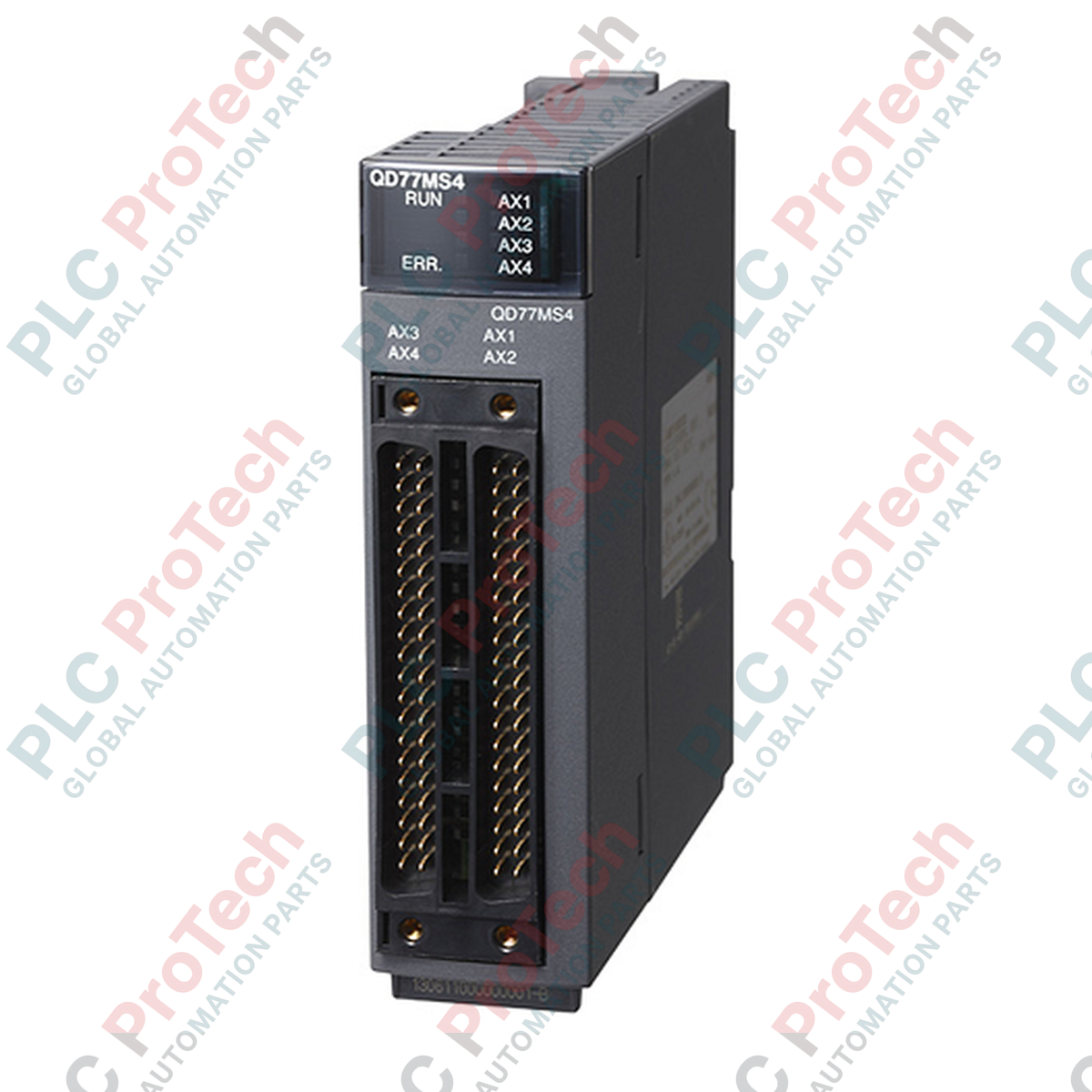
La gestion de profils de positionnement complexes et la synchronisation multiaxe au sein de l’architecture MELSEC Q Series constituent le rôle principal du module de mouvement simple Mitsubishi Electric QD77MS4. Ce module haute densité commande jusqu’à 4 axes indépendants ou synchronisés grâce au réseau à fibre optique SSCNET III/H, insensible aux parasites et à grande vitesse. En utilisant des cycles de fonctionnement rapides, il garantit des temps de réponse courts et un suivi précis des coordonnées dans les machines industrielles complexes.
Les ingénieurs peuvent facilement configurer des profils de mouvement avancés, notamment le positionnement point à point (PTP), l’interpolation linéaire et circulaire, les transitions de commande vitesse-couple et le profilage par came électronique, directement à l’aide du logiciel de programmation GX Works. L’intégration physique occupe un espace minimal dans le châssis de base, avec seulement 32 points d’E/S standard mobilisés.
Caractéristiques principales
- Prise en charge de la commande de mouvement multiaxe jusqu’à 4 axes sur une seule liaison SSCNET III/H.
- Cycles d’exécution ultrarapides de 0,88 ms ou 1,77 ms pour un suivi dynamique à grande vitesse.
- Configuration flexible des unités permettant la programmation indépendante de chaque axe en millimètres, pouces, degrés ou impulsions.
- Modes de transition avancés, notamment la commutation vitesse-position et position-vitesse, ainsi qu’une commande dédiée vitesse-couple.
- Mémoire flash haute endurance prenant en charge jusqu’à 100 000 opérations d’écriture pour le stockage persistant des paramètres.
Applications
- Machines d’emballage, d’encartonnage et de formage-remplissage-scellage horizontal/vertical en continu à grande vitesse.
- Couteaux rotatifs synchronisés, cisailles volantes et systèmes de bobinage précis de matériaux.
- Systèmes portiques multiaxes de prise et dépose, ainsi que stations automatisées d’insertion de composants.
- Systèmes de manutention nécessitant une régulation stricte de la vitesse et du couple pour le contrôle de la tension.
Spécifications techniques
| Paramètre |
Spécification |
| Fabricant |
Mitsubishi Electric |
| Numéro de modèle |
QD77MS4 |
| Série |
Série MELSEC Q |
| Type de module |
Module de mouvement simple |
| Nombre d’axes commandés |
4 axes |
| Cycle de fonctionnement |
0,88 ms / 1,77 ms |
| Modes de commande |
PTP (point à point), interpolation linéaire (jusqu’à 4 axes), interpolation circulaire (2 axes), vitesse, vitesse-position, position-vitesse, vitesse-couple |
| Unités de commande |
mm, pouce, degré, impulsion |
| Points d’E/S occupés |
32 points (affectation du module de fonction intelligent) |
| Consommation de courant interne (5 V CC) |
0,6 A |
| Capacité d’écriture de la mémoire ROM flash |
Maximum 100 000 écritures |
| Poids du module |
0,16 kg |
| Poids d’expédition (calculé) |
1,50 kg |
Connexions et interfaces
| Port / Connexion |
Spécification de l’interface / Fonction |
| Port SSCNET III/H |
Connexion à fibre optique haut débit (150 Mbps) pour la communication directe avec les servoamplificateurs MR-J4. |
| Connexion des entrées externes |
Connecteur frontal multipolaire pour les signaux de commande externes, tels que les interrupteurs de fin de course, les détecteurs de proximité et les signaux d’arrêt. |
Observations techniques empiriques
Modèles alternatifs et compatibilité
Le QD77MS4 constitue une voie de transition fonctionnelle depuis les anciens modules de la série QD75. Notez que, puisqu’il utilise le protocole de réseau à fibre optique SSCNET III/H, il ne peut pas être câblé directement en analogique ou au moyen de trains d’impulsions traditionnels vers des variateurs servo d’ancienne génération. Il nécessite des servoamplificateurs compatibles SSCNET III/H, tels que ceux de la série MELSERVO MR-J4, pour fonctionner correctement.
Pièges d’application et remarques d’ingénierie
Lors du cheminement des câbles à fibre optique (SSCNET III/H), veillez à ce que le rayon de courbure minimal des fibres ne soit pas inférieur à 25 mm. Le non-respect de cette limite provoquera une atténuation du signal, entraînant des défaillances intermittentes des communications et le déclenchement d’erreurs de mouvement, souvent sous la forme de pertes d’axes. Veillez également à recouvrir les ports inutilisés de capuchons antipoussière afin d’éviter toute dégradation des performances optiques.
Conseils de mise en service et de câblage
Faites toujours correspondre les numéros de station attribués au moyen des commutateurs rotatifs des servoamplificateurs MR-J4 physiques avec les axes matériels configurés dans l’outil de réglage du module Motion simple de GX Works. Toute discordance empêchera la synchronisation au démarrage et déclenchera des erreurs d’initialisation de la carte.
Consignes d’installation
AVERTISSEMENT CRITIQUE
Isolez et verrouillez toutes les sources d’alimentation externes avant d’installer ou de retirer des modules du châssis de l’API. Le non-respect de cette consigne peut entraîner un choc électrique, endommager physiquement les connecteurs du fond de panier ou provoquer une défaillance du module due à des surtensions transitoires.
1
Mettez hors tension l’ensemble du rack système et vérifiez l’absence de tension à l’aide d’un testeur industriel approprié.
2
Alignez le crochet inférieur du module QD77MS4 sur la fente de montage de l’unité de base MELSEC Q, puis appuyez fermement le module contre le connecteur du fond de panier jusqu’à ce qu’il s’enclenche.
3
Fixez la vis de verrouillage du module afin de relier le châssis métallique à la terre et au cadre du fond de panier.
4
Raccordez les câbles à fibre optique SSCNET III/H jusqu’à ce qu’ils s’enclenchent fermement dans les ports du terminal optique.