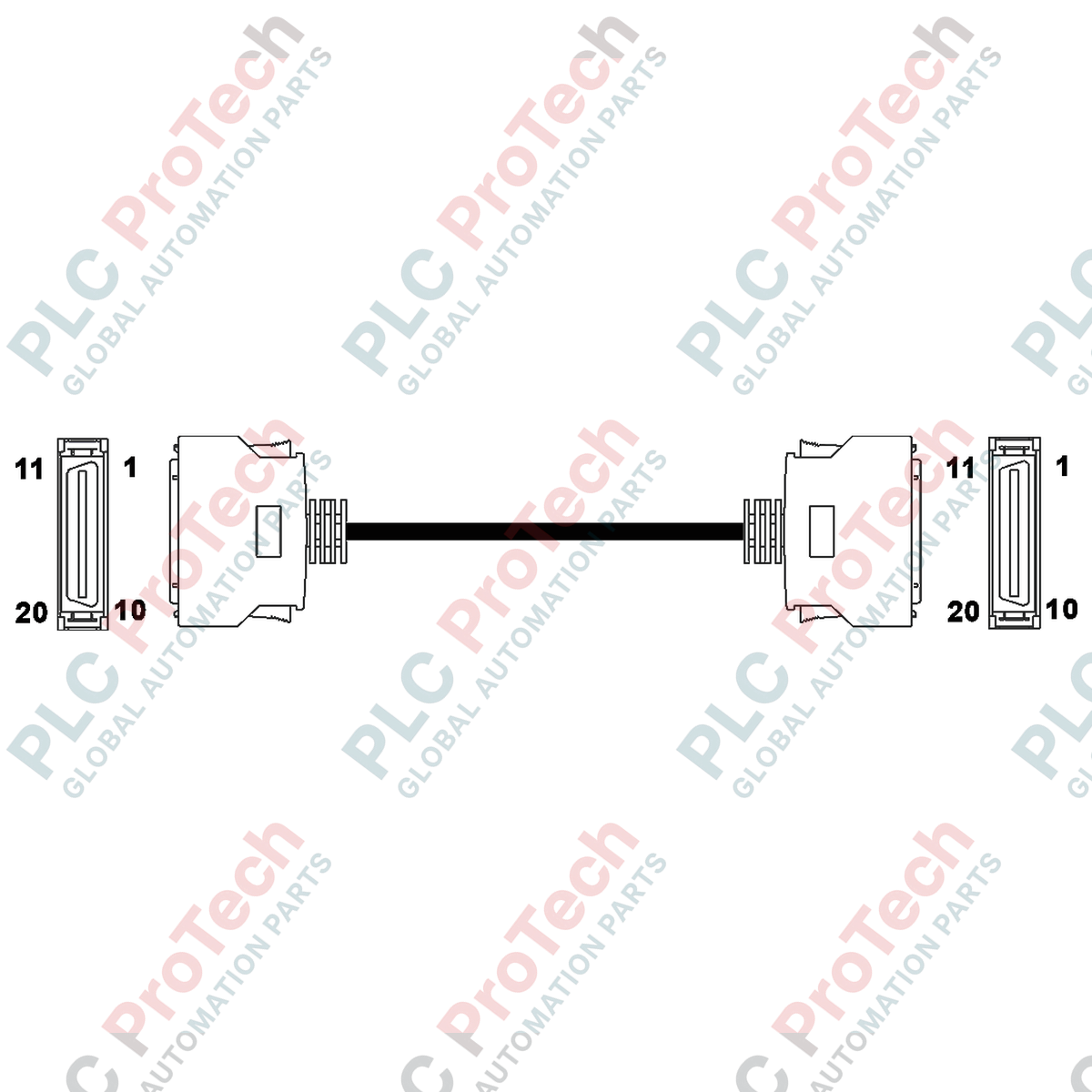
Présentation de l’infrastructure du système
Le Delta AHACABF0-5A (AHACABF0-5A) est un câble d’extension de fond de panier robuste et haute densité, conçu spécifiquement pour la plateforme d’automate programmable industriel (API) modulaire phare Delta AH500. Déployé dans de vastes centres de distribution industriels, des usines de dosage chimique à plusieurs niveaux et des lignes d’assemblage automobile à axe longitudinal, ce câble de bus spécialisé étend l’infrastructure des racks. En reliant le rack principal de traitement central aux racks d’extension distants, il permet au système de gérer le routage d’E/S haute densité sur de longues distances physiques tout en maintenant des débits de communication sur le fond de panier de l’ordre de la microseconde.
Interconnexion matérielle et compatibilité
Cette liaison d’interconnexion industrielle offre une portée physique de 60,0 mètres pour relier les racks de commande principaux aux châssis d’extension distants. Équipé de connecteurs haute densité (HDC) destinés à minimiser l’atténuation du signal et le retard de propagation sur une longue distance, le câble intègre un blindage interne multicouche afin de protéger les lignes d’horloge haute fréquence du fond de panier contre les perturbations électromagnétiques industrielles. L’AHACABF0-5A est validé pour un déploiement direct avec les bases de racks Delta AH500 suivantes :
-
Bases de racks principaux : AHBP04M1-5A (4 emplacements), AHBP06M1-5A (6 emplacements), AHBP08M1-5A (8 emplacements) et AHBP12M1-5A (12 emplacements).
-
Bases de racks d’extension : AHBP06E1-5A (6 emplacements) et AHBP08E1-5A (8 emplacements).
Tableau des performances techniques
| Paramètre du système |
Spécification fonctionnelle |
| Référence du modèle |
AHACABF0-5A |
| Marque / plateforme matérielle |
Delta Electronics / API de la série AH500 |
| Classification du composant |
Câble d’extension de fond de panier haute densité (HDC) |
| Longueur physique du câble |
60,0 mètres |
| Application principale |
Interconnexion des fonds de panier du processeur principal avec les racks d’extension |
| Architecture des connecteurs |
Connecteurs d’interface multipoints robustes haute densité |
| Structure du blindage |
Tresse en cuivre étamé multibrins avec enroulement en feuille d’aluminium |
| Rayon de courbure admissible |
Minimum 10 fois le diamètre extérieur du câble lors de l’installation |
| Température de fonctionnement |
-20 à 60 °C |
| Température de stockage |
-40 à 80 °C |
| Poids net de l’ensemble |
0,82 kg |
| Poids brut d’expédition |
1,0 kg (enroulé dans un carton antistatique de protection) |
Diagnostic industriel et FAQ
Quelles sont les principales procédures de dépannage si l’UC signale un défaut de perte du rack d’extension (erreur de liaison matérielle) ?
Une erreur de liaison matérielle sur une portée de 60,0 mètres indique une rupture de la continuité des données du fond de panier. Commencez par couper l’alimentation du système et vérifiez que les connecteurs haute densité sont complètement insérés et verrouillés dans les ports d’extension des racks AHBP. Inspectez le câble sur toute sa longueur afin de détecter d’éventuels plis marqués, points de pincement ou entailles de l’isolant extérieur causées par des machines voisines. Nettoyez les broches des connecteurs avec un nettoyant pour contacts électroniques afin d’éliminer toute pellicule de graisse ou de poussière en suspension avant de redémarrer le système.
Ce câble de 60,0 mètres peut-il être coupé et raccordé pour s’adapter à des parcours plus courts dans l’usine ?
Non. L’AHACABF0-5A est une liaison de bus de données à haute impédance, étalonnée en usine, présentant des caractéristiques précises de résistance interne et de délai de propagation adapté. Couper, raccorder ou utiliser des borniers standard pour modifier la longueur du câble changera son impédance caractéristique. Cela peut provoquer des réflexions de signaux haute fréquence, une corruption des paquets de données et des décrochages intermittents des racks. Pour les distances plus courtes, utilisez le modèle de câble Delta approprié, terminé en usine.
Ce câble fournit-il l’alimentation aux racks distants du fond de panier d’extension ?
Non. Ce câble haute densité transporte les signaux logiques, les états d’adressage et les bus de communication du système entre les racks. Il ne transfère pas l’alimentation de fonctionnement des équipements de terrain ni celle du fond de panier. Chaque rack d’extension distant (tel que l’AHBP06E1-5A) doit être équipé de son propre module d’alimentation dédié de la série AH500 pour alimenter ses cartes d’E/S locales.
Consignes de mise en service et d’acheminement sur site
-
Alignement et verrouillage des connecteurs : Lors de l’insertion des connecteurs haute densité dans les ports du fond de panier, alignez perpendiculairement la rangée de broches avec la prise. Enfoncez le connecteur bien droit jusqu’à son insertion complète, puis serrez les leviers de verrouillage mécaniques intégrés ou les vis de retenue. Évitez de tordre ou de faire osciller le connecteur pendant l’insertion afin de ne pas plier ni casser les broches d’interface de précision.
-
Séparation des conduits et isolation contre les parasites : Comme ce câble parcourt 60,0 mètres dans des environnements industriels, acheminez-le dans un conduit métallique dédié mis à la terre ou dans un chemin de câbles séparé pour circuits basse tension. Maintenez-le à au moins 300 mm des lignes d’alimentation CA triphasées haute tension, des câbles de moteur et des câbles de sortie des variateurs de fréquence (VFD) afin d’éviter que les interférences électromagnétiques ne perturbent le cycle de données du fond de panier de l’API.
-
Décharge de traction et respect du rayon de courbure : Ne laissez pas l’ensemble de câbles pendre sans support à partir des connecteurs du fond de panier, car une traction structurelle continue exercerait une contrainte sur les connexions internes. Installez des colliers de câbles robustes ou des supports à moins de 100 mm de chaque point de raccordement. Maintenez un parcours courbe régulier, largement supérieur à la limite minimale de rayon de courbure admissible, afin de protéger les conducteurs centraux haute vitesse contre la fatigue interne.