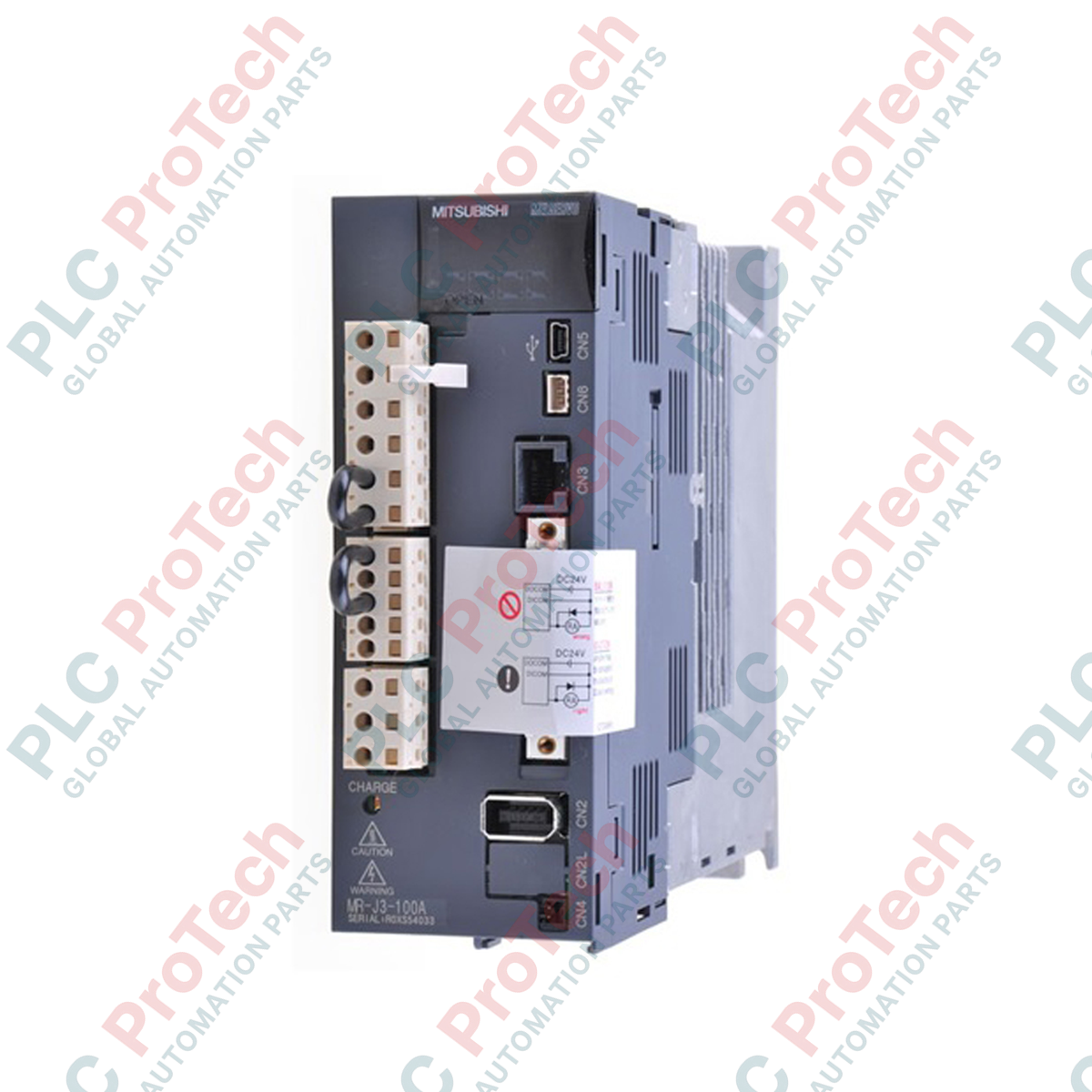
S'intégrant parfaitement dans des architectures de contrôle de mouvement haute performance, le servo-variateur Mitsubishi Electric MR-J3-11KA4 offre un contrôle en boucle fermée précis pour les systèmes moteurs industriels. Conçu pour des applications exigeantes de classe 400V, cet amplificateur de 11 kW fournit une réponse dynamique à couple élevé et une précision de positionnement exceptionnelle. Il intègre des algorithmes avancés de suppression des vibrations et un auto-réglage en temps réel pour s'adapter aux charges mécaniques variables, garantissant une opération stable dans les environnements de fabrication à grande vitesse.
Caractéristiques principales
- Support de retour d'encodeur haute résolution pour une précision de positionnement submicronique.
- Contrôle avancé de suppression adaptative des vibrations pour éliminer la résonance mécanique.
- Système de ventilation à refroidissement forcé avec double ventilateur intégré pour régulation thermique continue.
- Auto-réglage en temps réel ajustant dynamiquement les gains de la boucle de contrôle selon l'inertie de charge.
- Capacités de diagnostic intégrées pour surintensité, surtension et défauts de communication d'encodeur.
Applications
- Centres d'usinage CNC multi-axes et machines de formage de précision des métaux.
- Lignes de production à grande vitesse pour emballage, étiquetage et impression.
- Manutention automatisée, systèmes portiques et robotique industrielle lourde.
- Systèmes d'assemblage automobile et dispositifs de test automatisés.
Spécifications techniques
| Paramètre |
Valeur de spécification |
| Fabricant |
Mitsubishi Electric |
| Numéro de modèle |
MR-J3-11KA4 |
| Série |
Série MELSERVO MR-J3 (classe 400V) |
| Puissance de sortie nominale |
11 kW |
| Tension nominale de sortie |
Triphasé 323 V AC |
| Courant nominal de sortie |
32,0 A |
| Alimentation du circuit principal |
Alimentation secteur triphasée 380 à 480 V AC, 50/60 Hz |
| Courant nominal du circuit principal |
23,1 A |
| Fluctuation de tension admissible |
Triphasé 323 à 528 V AC |
| Fluctuation de fréquence admissible |
Dans ±5% |
| Alimentation du circuit de commande |
Alimentation secteur monophasée 380 à 480 V AC, 50/60 Hz |
| Courant nominal du circuit de commande |
0,2 A |
| Consommation électrique du circuit de commande |
45 W |
| Structure de refroidissement |
Refroidissement forcé (ventilateur intégré) |
| Frein dynamique |
Option externe |
| Poids net |
18 kg |
| Poids d'expédition (calculé) |
20 kg |
| Dimensions de l'emballage (calculées) |
450 mm x 320 mm x 380 mm |
| Pays d'origine |
Japon |
Connexions et interfaces
| Bornier / Port |
Fonction / Attribution du circuit |
| L1 / L2 / L3 |
Alimentation secteur triphasée 3 phases pour circuit principal |
| L11 / L21 |
Alimentation secteur monophasée 1 phase pour circuit de commande |
| U / V / W |
Connexions de sortie d'alimentation du moteur servo (Phase U, V, W) |
| CN1 |
Connecteur de signal E/S (interface 50 broches pour signaux de commande) |
| CN2 |
Connecteur de retour d'encodeur (interface série haute vitesse 10 broches) |
| CN3 |
Port de communication PC (connexion RS-422 pour MR Configurator) |
Aperçus empiriques d'ingénierie
Modèles alternatifs et compatibilité
Le MR-J3-11KA4 est un amplificateur de classe 400 V et 11 kW. Lors de la migration vers la série plus récente MR-J4 (comme le MR-J4-11K-RJ4), un câble de conversion spécialisé est nécessaire pour interfacer avec les moteurs des séries HC-SFS ou HA-LPS existants. Assurez-vous que la traduction des paramètres est effectuée via MR Configurator2 pour mapper précisément les réglages de gain hérités sur la nouvelle plateforme matérielle.
Pièges d'application et notes d'ingénierie
En raison de la forte dissipation thermique de cette unité de 11 kW, les installations standard en armoire fermée doivent maintenir un dégagement minimum de 80 mm au-dessus et en dessous du châssis. Assurez-vous que la température ambiante interne du coffret ne dépasse pas 55 °C. Pour les profils à forte inertie ou décélération rapide, la capacité régénérative interne est insuffisante ; une résistance régénérative externe (comme la MR-RB137-4) doit être installée et enregistrée dans le paramètre PA02 pour éviter les défauts de surtension (AL.33).
Conseils pour la mise en service et le câblage
Routiez toujours le câble de retour d'encodeur (CN2) séparément des lignes d'alimentation principales du moteur (U/V/W) avec au moins 30 cm de séparation physique pour éviter les interférences électromagnétiques. Mettez la masse de la gaine du câble d'encodeur directement à la borne de terre de l'amplificateur. Lors de la mise sous tension initiale, vérifiez que le circuit de commande (L11/L21) est alimenté avant ou simultanément au circuit principal (L1/L2/L3) pour éviter les défauts de perte de phase.
Consignes d'installation
AVERTISSEMENT CRITIQUE : RISQUE DE HAUTE TENSION
Assurez-vous que toutes les sources d'alimentation en courant alternatif (L1/L2/L3 et L11/L21) sont complètement hors tension avant toute installation, câblage ou maintenance. Attendez au moins 20 minutes après la coupure de courant pour que les condensateurs du bus interne se déchargent. Vérifiez que la LED de charge sur le panneau avant est complètement éteinte et mesurez la tension du bus DC pour vous assurer qu'elle est inférieure à 20 V avant de toucher aux bornes électriques.
1
Montez l'amplificateur verticalement sur une surface métallique plane et sans vibrations pour assurer une dissipation thermique correcte.
2
Connectez la borne de terre de protection (PE) au barrette de terre du coffret avant de réaliser toute autre connexion.
3
Câblez l'alimentation du circuit de commande (L11/L21) et l'alimentation du circuit principal (L1/L2/L3) en utilisant les sections de câble spécifiées.
4
Connectez les lignes d'alimentation du servomoteur (U/V/W) et branchez le câble de retour d'encodeur (CN2).
5
Interfacez les signaux de commande via CN1 et connectez l'interface de communication pour la mise en service.