Description
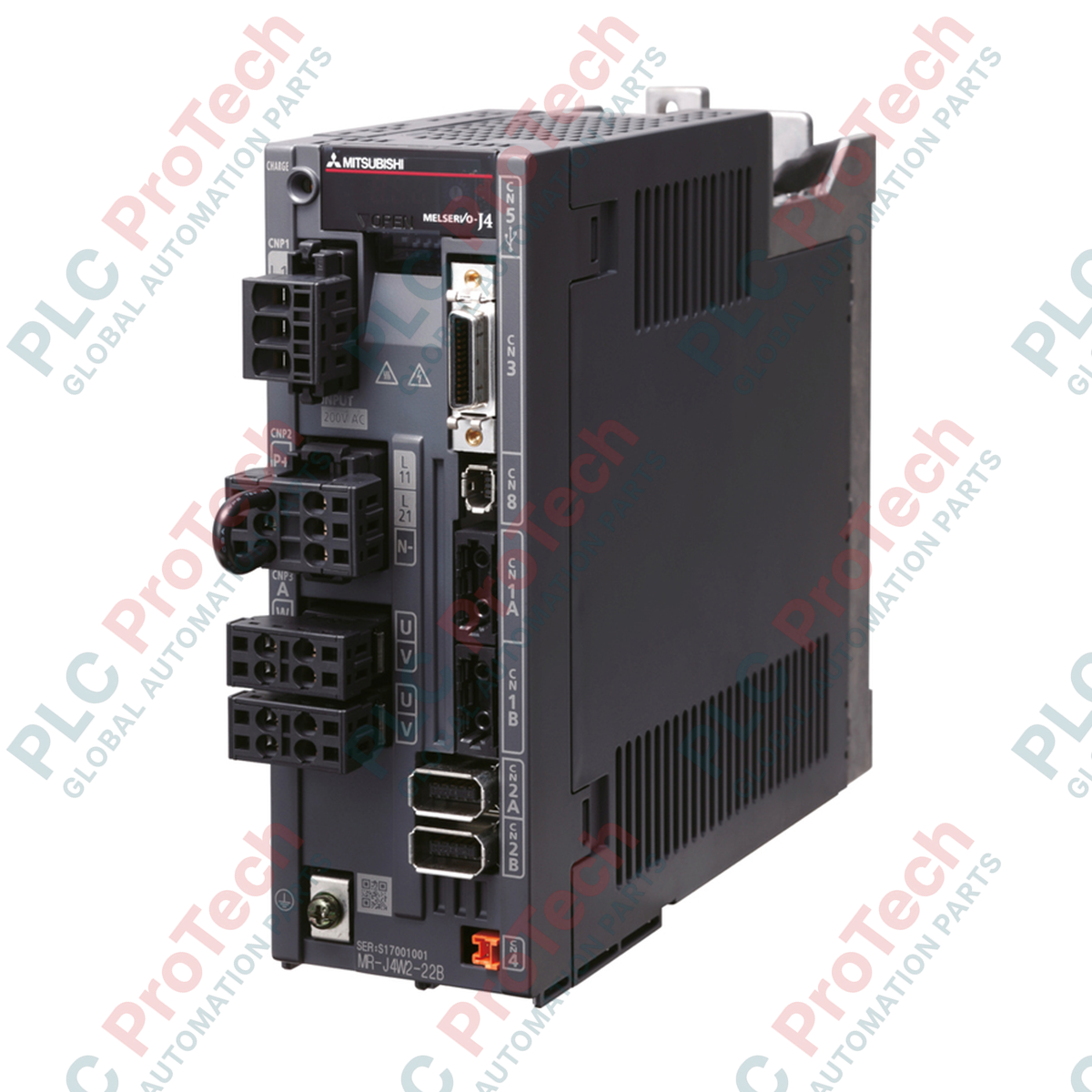
Conçu pour le contrôle de mouvement multiaxe haute performance, le Mitsubishi Electric MR-J4W2-1010B est un amplificateur servo CA à deux axes de la gamme MELSERVO-J4. Cette unité intègre deux axes de commande indépendants de 1,0 kW dans un seul boîtier, réduisant considérablement l’encombrement dans l’armoire et simplifiant le câblage. Doté d’une communication optique haut débit SSCNET III/H, il assure une commande synchrone rapide avec un retour d’information en temps réel. L’amplificateur est conçu pour prendre en charge les servomoteurs rotatifs, linéaires et à entraînement direct, et s’adapte aux profils de mouvement complexes grâce à la suppression intégrée des vibrations et à des fonctions de réglage avancées.
Fonctionnalités
-
Intégration à deux axes : commande deux servomoteurs de 1,0 kW depuis une seule unité, réduisant l’espace d’installation jusqu’à 30 % par rapport à des variateurs individuels.
-
Protocole SSCNET III/H : système de communication optique haut débit fonctionnant à 150 Mbps pour une synchronisation précise et insensible au bruit.
-
Architecture à bus CC commun : permet d’utiliser dynamiquement l’énergie régénérée lors de la décélération d’un axe pour l’autre axe en accélération, optimisant ainsi l’efficacité énergétique globale.
-
Réglage avancé à une touche : estimation en temps réel de l’inertie de la charge mécanique pour régler et maintenir automatiquement les gains optimaux du servomoteur.
-
Fonctions de sécurité complètes : prend en charge la fonction Safe Torque Off (STO) afin de satisfaire aux normes de sécurité fonctionnelle industrielles.
Applications
- Systèmes portiques multiaxes de prélèvement et de placement
- Machines d’emballage, de conditionnement et de scellage
- Lignes d’assemblage de semi-conducteurs et de composants électroniques
- Systèmes de manutention et de tri de matériaux de précision
Tableau des spécifications techniques
| Paramètre |
Valeur de spécification |
| Fabricant |
Mitsubishi Electric |
| Code modèle |
MR-J4W2-1010B |
| Nom de la série |
MELSERVO-J4 (série MR-J4) |
| Nombre d’axes commandés |
2 axes (axe A et axe B) |
| Puissance de sortie nominale |
1,0 kW (axe A) + 1,0 kW (axe B) |
| Alimentation du circuit principal |
Alimentation du circuit principal : triphasée, 200 V CA à 240 V CA, 50/60 Hz |
| Alimentation du circuit de commande |
Alimentation de commande : monophasée, 200 V CA à 240 V CA, 50/60 Hz |
| Interface de communication |
SSCNET III/H (réseau optique haut débit) |
| Méthode de commande |
Commande PWM sinusoïdale / système de commande du courant |
| Méthode de refroidissement |
Ventilateur de refroidissement forcé |
| Température ambiante de fonctionnement |
0 à 55 °C (sans gel) |
| Humidité ambiante de fonctionnement |
5 % à 90 % HR (sans condensation) |
| Poids de l’unité |
2,3 kg |
| Dimensions (L x H x P) |
85 mm x 168 mm x 195 mm |
Connexions et interfaces
| Borne / port de connexion |
Affectation des fonctions / circuits |
| CN1A |
Connexion avant SSCNET III/H (entrée optique depuis le contrôleur ou le variateur précédent) |
| CN1B |
Connexion arrière SSCNET III/H (sortie optique vers le variateur suivant de la ligne réseau) |
| CN2A |
Connecteur d’entrée du codeur de l’axe A |
| CN2B |
Connecteur d’entrée du codeur de l’axe B |
| L1, L2, L3 |
Bornes d’entrée de l’alimentation principale (triphasée, 200–240 V CA) |
| L11, L21 |
Bornes d’entrée de l’alimentation de commande (monophasée, 200–240 V CA) |
| U, V, W (axe A) |
Bornes de sortie de puissance du servomoteur de l’axe A |
| U, V, W (axe B) |
Bornes de sortie d’alimentation du servomoteur de l’axe B |
Observations techniques empiriques
Modèles alternatifs et compatibilité
Lors du remplacement de deux amplificateurs MR-J4-100B distincts à un axe par une seule unité MR-J4W2-1010B, assurez-vous d’utiliser MR Configurator2 (version 1.20W ou ultérieure). Le logiciel gère cette unité à deux axes sous une seule adresse de station physique, avec des onglets de paramètres pour chaque sous-axe. Vérifiez que la carte de configuration de votre réseau API a attribué des adresses consécutives aux axes A et B dans la configuration du Simple Motion Module ou du contrôleur de mouvement.
Pièges liés à l’application et remarques techniques
Comme l’axe A et l’axe B partagent une seule résistance de régénération intégrée, la décélération simultanée de deux charges à forte inertie déclenchera rapidement des défauts de surtension régénérative (défauts AL.30 ou AL.33). Si les deux axes fonctionnent selon des séquences répétées de démarrage et d’arrêt rapides, nous recommandons vivement d’installer une option de régénération externe (telle que la MR-RB12) afin de contourner les limites internes et d’éviter la surcharge thermique du bus intégré.
Conseils de mise en service et de câblage
Les câbles à fibre optique SSCNET III/H (CN1A et CN1B) sont extrêmement sensibles à la contamination par des particules. Utilisez un liquide de nettoyage dédié et des lingettes non pelucheuses sur les extrémités des fibres avant le raccordement. Une infime particule de poussière peut dégrader l’intensité du signal et provoquer des erreurs intermittentes de commande SSCNET (AL.37 ou AL.E4). Respectez le rayon de courbure minimal de 25 mm pour les câbles à fibre standard ; des courbures plus serrées peuvent atténuer définitivement le signal de la liaison optique.
Directives d’installation
AVERTISSEMENT CRITIQUE
Isolez et verrouillez tous les circuits du secteur triphasé (L1/L2/L3) et de l’alimentation de commande (L11/L21) avant toute intervention sur le câblage. Une charge haute tension reste stockée dans les condensateurs du bus CC interne après la coupure de l’alimentation. Attendez toujours au moins 15 minutes et vérifiez que la tension entre les bornes P+ et N- est inférieure à 50 VCC à l’aide d’un multimètre numérique correctement homologué avant de commencer la maintenance.
1
Montez l’amplificateur verticalement sur une plaque de montage métallique non peinte, à l’intérieur d’un panneau de commande propre, en garantissant un contact de mise à la terre solide de surface à surface. Laissez un dégagement de 10 mm de chaque côté du châssis et de 40 mm en haut et en bas afin d’assurer une convection thermique adéquate.
2
Raccordez la borne PE à la barre omnibus principale de mise à la terre de l’armoire à l’aide d’un câble de terre épais à faible impédance. Une mise à la terre correcte empêche les interférences CEM et les pertes de retour codeur dues au bruit.
3
Câblez les câbles d’alimentation moteur (U, V, W) en identifiant précisément l’axe A et l’axe B. L’association de câbles moteur aux mauvaises voies de retour codeur entraînera une mise en emballement immédiate et incontrôlée, ainsi qu’un défaut de retour d’information au démarrage.
4
Insérez les connecteurs à fibre optique SSCNET III/H dans les ports CN1A et CN1B jusqu’à entendre un clic mécanique net. Fixez les clips du capot des connecteurs afin d’éviter tout desserrage dû aux vibrations.