Description
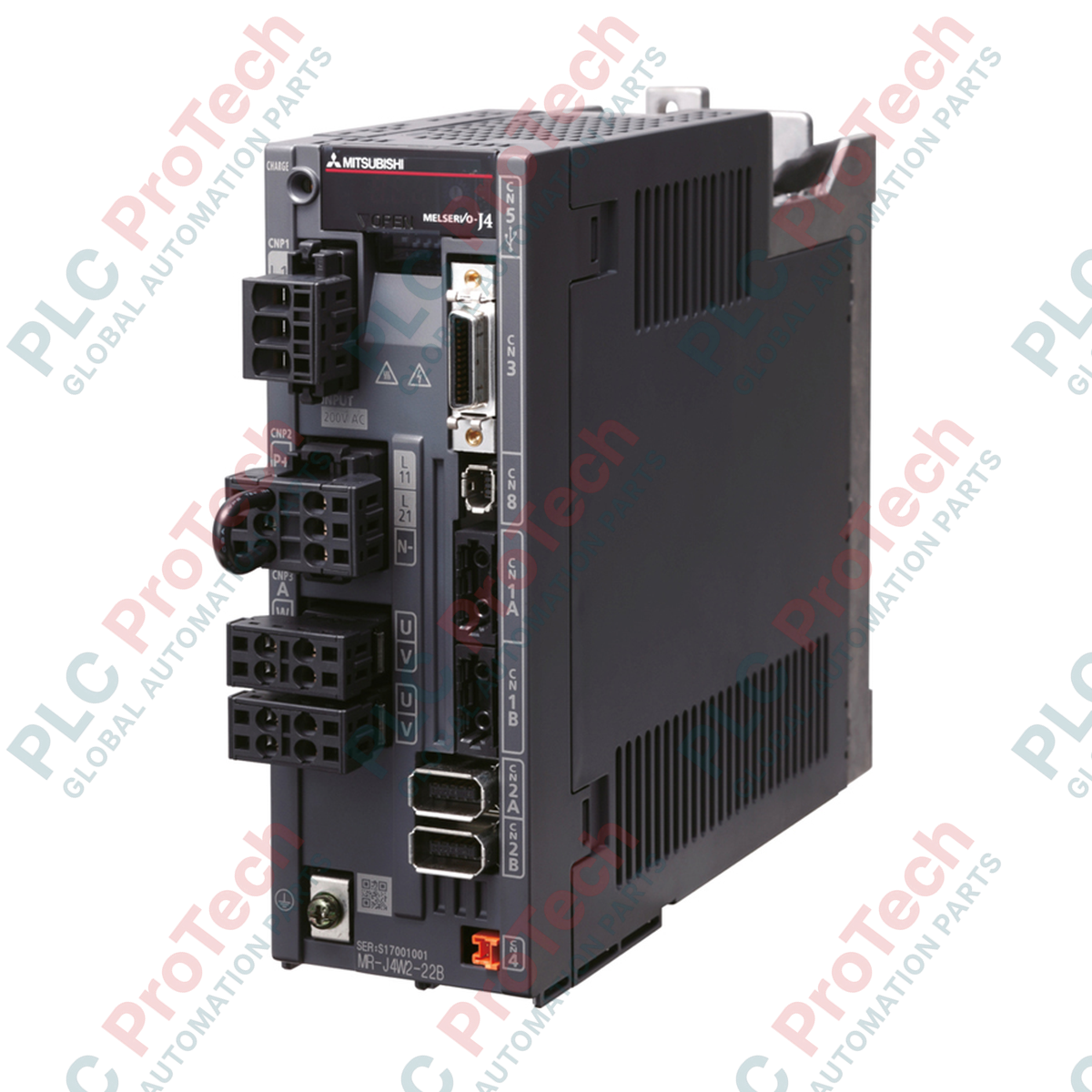
Conçu pour exécuter une commande multiaxe synchronisée dans un format compact et peu encombrant, le Mitsubishi Electric MR-J4W2-44B est un amplificateur servomoteur CA numérique double axe reposant sur la plateforme MELSERVO-J4. En regroupant l’électronique de commande de deux axes indépendants de 0,4 kW, cette unité réduit considérablement l’encombrement des tableaux de commande, optimise la distribution de l’alimentation et simplifie le routage réseau. L’intégration de communications par fibre optique haut débit SSCNET III/H permet une synchronisation des mouvements haute résolution avec des interférences électromagnétiques négligeables, ce qui en fait un choix idéal pour les systèmes d’assemblage automatisés multiaxes à grande vitesse.
Caractéristiques
-
Intégration double axe : commande deux servomoteurs rotatifs ou linéaires indépendants jusqu’à 0,4 kW chacun, réduisant jusqu’à 30 % l’espace requis dans l’armoire.
-
Protocole SSCNET III/H : bus optique haute vitesse fonctionnant à 150 Mbit/s pour une commande synchronisée précise et déterministe, avec une immunité totale au bruit.
-
Commande avancée de suppression des vibrations II : compense dynamiquement la résonance mécanique des éléments structurels haute fréquence et l’oscillation de charge basse fréquence.
-
Réglage à une touche : l’estimation en temps réel du rapport d’inertie mécanique permet un réglage automatique instantané des gains du servomoteur.
-
Prise en charge de la sécurité fonctionnelle : fonctions intégrées de désactivation sûre du couple (STO) conformes aux normes de sécurité internationales.
Applications
- Machines d’emballage multiaxes synchronisées et lignes de mise en carton.
- Robots portiques pick-and-place à grande vitesse et systèmes d’assemblage de semi-conducteurs.
- Tables de positionnement X-Y de précision et convoyeurs de manutention des matériaux.
- Machines automatisées de bobinage, d’indexage et d’étiquetage.
Tableau des spécifications techniques
| Fabricant |
Mitsubishi Electric |
| Numéro de modèle |
MR-J4W2-44B |
| Nom de la série |
MELSERVO-J4 (MR-J4) |
| Axes commandés |
2 axes (axe A et axe B) |
| Puissance de sortie nominale |
0,4 kW par axe (total de 0,8 kW) |
| Interface de communication |
SSCNET III/H (connexion optique) |
| Alimentation du circuit principal |
Triphasé, 200 à 240 V CA, 50/60 Hz |
| Alimentation du circuit de commande |
Monophasé, 200 à 240 V CA, 50/60 Hz |
| Compatibilité avec les codeurs |
Systèmes absolus/incrémentaux 22 bits |
| Méthode de refroidissement |
Refroidissement naturel |
| Température ambiante de fonctionnement |
De 0 à 55 °C (sans gel) |
| Dimensions (H x l x P) |
195 mm x 60 mm x 168 mm |
| Poids net |
1,4 kg |
| Poids d’expédition (calculé) |
3,5 kg |
Connexions et interfaces
| Code de borne / connecteur |
Affectation fonctionnelle |
| L1 / L2 / L3 |
Entrée d’alimentation du circuit principal (200-240 V CA) |
| L11 / L21 |
Entrée d’alimentation du circuit de commande |
| U / V / W (axe A) |
Bornes de sortie du servomoteur pour l’axe A |
| U / V / W (axe B) |
Bornes de sortie du servomoteur pour l’axe B |
| CN1A / CN1B |
Connecteurs de boucle à fibre optique SSCNET III/H (entrée/sortie) |
| CN2A / CN2B |
Interfaces de connexion de l’encodeur pour les axes A et B |
| CN8 |
Connecteur de signal de sécurité fonctionnelle (STO) |
Modèles alternatifs et compatibilité
La série MR-J4W2 est conçue comme plateforme principale pour les configurations multiaxes au sein de l’écosystème MR-J4. Notez que lors de la migration d’unités MR-J3W existantes vers une configuration MR-J4W2, une conversion des paramètres dans la suite de programmation (telle que GX Works2 ou GX Works3) est nécessaire. Bien que les encombrements de montage diffèrent légèrement de ceux des unités à axe unique, le gain d’espace obtenu en supprimant les câbles d’alimentation de commande indépendants justifie largement cette transition.
Pièges liés à l’application et remarques techniques
Comme les axes A et B partagent un bus CC interne commun, l’énergie régénérative produite par la décélération d’un axe est naturellement utilisée par le second axe en fonctionnement moteur. Toutefois, si les deux axes subissent simultanément une décélération à forte inertie, la capacité de régénération peut rapidement saturer le condensateur interne et déclencher un défaut de surtension (AL.33). Pour les opérations comportant des cycles de régénération continus ou une forte inertie de charge, calculez toujours les besoins totaux de régénération du système et raccordez une résistance de régénération externe de dimension appropriée entre les bornes L+ et L-.
Conseils de mise en service et de câblage
Lors de la pose des câbles à fibre optique SSCNET III/H (MR-J3BUS_M), ne dépassez pas le rayon de courbure minimal de 25 mm. Les courbures prononcées ou une tension excessive exercée par les serre-câbles sur le cheminement de la fibre optique atténueront le signal lumineux, ce qui peut entraîner des défaillances aléatoires de ligne (AL.37) ou des erreurs de communication (AL.E6). Bouchez toujours les ports optiques inutilisés de l’amplificateur afin d’éviter la contamination par la poussière et l’humidité de la lentille du transceiver optique.
Consignes d’installation
AVERTISSEMENT CRITIQUE :
Risque de choc électrique et de décharge de charge résiduelle. Déconnectez toujours les alimentations du circuit principal et du circuit de commande avant de commencer l’installation physique ou le câblage. Après la mise hors tension, attendez au moins 15 minutes que les voyants de charge internes situés sur la face avant de l’amplificateur s’éteignent complètement avant de manipuler les connexions des câbles.
1
Montez l’amplificateur servo verticalement sur une surface métallique plane et non peinte afin de garantir une mise à la terre à faible impédance et de maximiser le transfert thermique.
2
Veillez à laisser un espace libre d’au moins 40 mm au-dessus et au-dessous du boîtier, et d’au moins 10 mm de chaque côté du châssis, afin de permettre une circulation d’air sans obstruction.
3
Raccordez la borne de terre de protection (PE) au panneau de mise à la terre de l’armoire avant de connecter toute phase d’alimentation d’entrée ou tout câble d’encodeur.