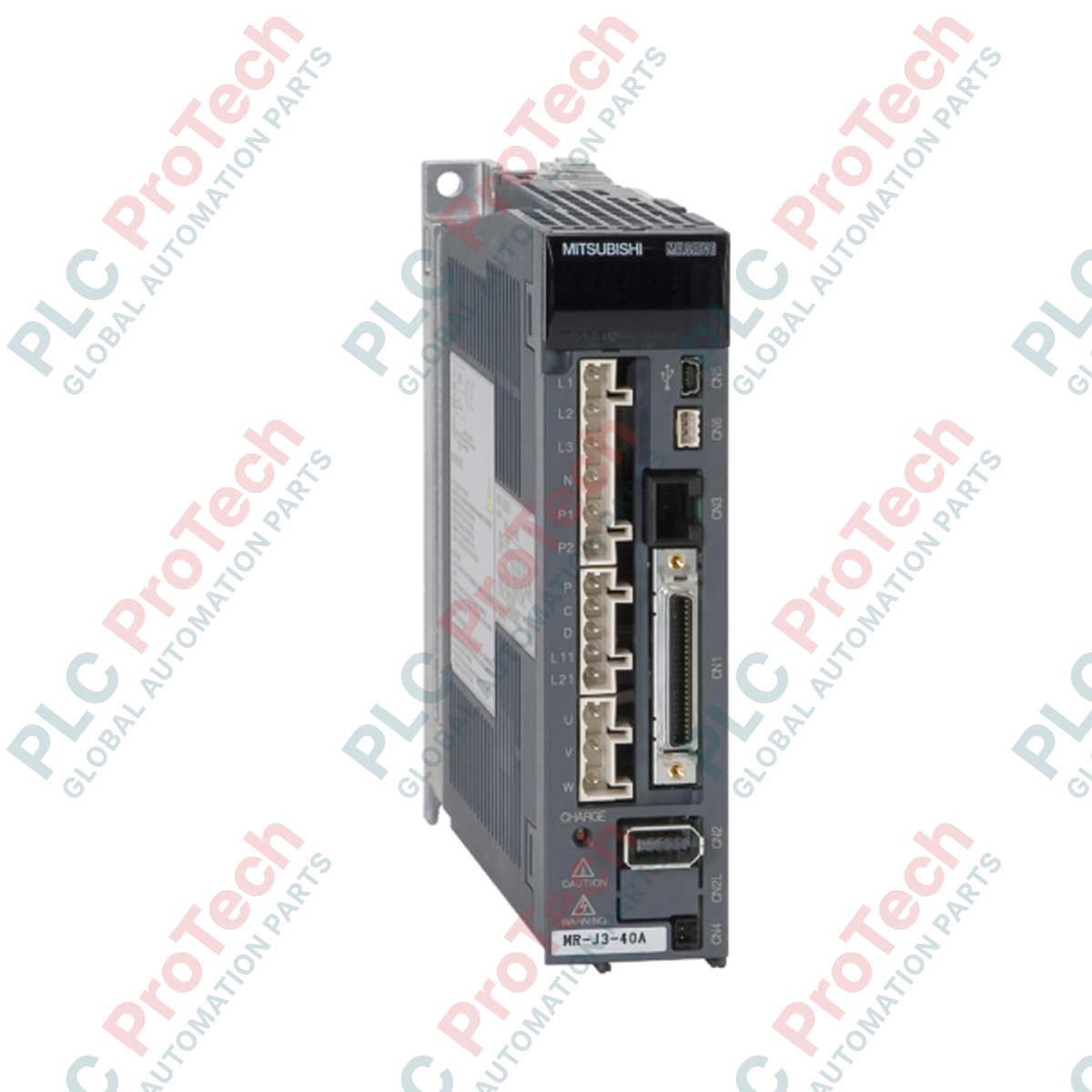
Description
Conçu pour assurer un contrôle précis de la vitesse, du couple et de la position dans les environnements industriels exigeants, le Mitsubishi Electric MR-J3-500A4 est un amplificateur servo numérique hautes performances appartenant à la famille de produits MELSERVO série MR-J3. Cette unité fonctionne sur un réseau de classe 400 V et est optimisée pour piloter des servomoteurs sans balais nécessitant un courant continu maximal de 14.0 A. Grâce à un réglage automatique avancé en temps réel et à des filtres de suppression des vibrations, cet amplificateur garantit une réponse élevée tout en limitant la résonance mécanique sur les axes critiques.
Caractéristiques principales
-
Commande à double boucle de rétroaction : prend en charge des boucles de positionnement de haute précision grâce au traitement des signaux d’encodeur haute résolution.
-
Freinage dynamique intégré : le circuit matériel de freinage dynamique intégré permet une décélération rapide et sûre du moteur en cas d’arrêt d’urgence.
-
Gestion thermique robuste : la conception à refroidissement forcé, dotée de ventilateurs intégrés, maintient des températures optimales pendant les cycles de fonctionnement intensifs.
-
Tolérance aux hautes tensions : l’alimentation principale prend en charge des plages d’entrée allant jusqu’à 480 V CA afin de permettre l’intégration aux réseaux mondiaux de distribution électrique.
Applications
-
Machines-outils CNC : centres d’usinage et de tournage multiaxes à couple élevé.
-
Emballage et assemblage : machines d’emballage de produits à action rapide et synchronisée, et lignes d’assemblage à plusieurs étapes.
-
Systèmes de manutention des matériaux : ponts roulants à positionnement dynamique, chargeurs robotisés pour charges élevées et lignes de triage à convoyeurs.
Spécifications techniques
| Paramètre |
Spécification technique |
| Fabricant |
Mitsubishi Electric |
| Code modèle |
MR-J3-500A4 |
| Gamme de produits |
MELSERVO série MR-J3 |
| Alimentation du circuit principal |
CA triphasé de 380 à 480 V, 50/60 Hz |
| Fluctuation de tension admissible |
CA triphasé de 323 à 528 V |
| Courant nominal du circuit principal |
10.8 A |
| Alimentation du circuit de commande |
CA monophasé de 380 à 480 V, 50/60 Hz |
| Courant nominal du circuit de commande |
0.2 A |
| Consommation du circuit de commande |
45 W |
| Tension de sortie nominale |
CA triphasé 323 V |
| Courant de sortie nominal |
14.0 A |
| Freinage dynamique |
Intégré |
| Système de refroidissement |
Refroidissement forcé (ventilateur de refroidissement intégré) |
| Poids net |
4.6 kg |
| Poids d’expédition (calculé) |
6.0 kg |
Connexions et interfaces
| Borne / connecteur |
Affectation de la fonction / du circuit |
| L1, L2, L3 |
Entrée d’alimentation CA triphasée du circuit principal |
| L11, L21 |
Entrée d’alimentation CA monophasée du circuit de commande |
| U, V, W |
Bornes de sortie d’alimentation du servomoteur |
| CN1 |
Interface d’E/S analogiques polyvalente / train d’impulsions |
| CN2 |
Entrée de retour du codeur haute résolution |
| CN3 |
Interface de connexion au PC ou de l’unité de configuration des paramètres |
Observations techniques empiriques
Modèles alternatifs et compatibilité
Le MR-J3-500A4 est la variante polyvalente non mise en réseau à commande analogique/train d’impulsions de la série MR-J3 400V. Notez qu’il ne peut pas remplacer directement le MR-J3-500B4, conçu exclusivement pour le réseau à fibre optique SSCNET III. Vérifiez la compatibilité de l’interface côté contrôleur avant le déploiement.
Pièges liés à l’application et remarques techniques
En raison de la dissipation thermique élevée en fonctionnement continu à forte charge, les concepteurs d’armoires doivent prévoir un espace libre vertical minimal de 40 mm au-dessus et au-dessous de l’amplificateur. En cas d’installation de plusieurs amplificateurs côte à côte dans un panneau fermé, maintenez une température ambiante de fonctionnement inférieure à 55 degC afin d’éviter les déclenchements prématurés de la protection contre la surchauffe.
Conseils de mise en service et de câblage
Pour éviter les interférences électromagnétiques (EMI) haute fréquence provenant de la sortie de l’onduleur PWM, assurez-vous que les câbles d’alimentation du moteur sont correctement blindés et mis à la terre sur la plaque de base commune. De plus, le câblage des lignes de commande du connecteur CN1 doit utiliser des paires torsadées blindées, séparées du câblage primaire de puissance.
Directives d’installation
AVERTISSEMENT CRITIQUE
Avant de commencer toute procédure d’installation, d’entretien ou de câblage, isolez et mettez hors tension toutes les tensions d’entrée principales et de commande. Attendez au moins 15 minutes pour permettre aux condensateurs internes du bus CC haute tension de se décharger à un niveau sûr. Vérifiez, à l’aide d’un multimètre étalonné, que la tension du bus CC est nulle avant tout contact physique avec les bornes.
1
Montez l’amplificateur servo verticalement sur une surface plane et ininflammable, à l’intérieur d’une armoire de commande exempte de poussière et d’humidité.
2
Raccordez directement la borne de terre de protection (PE) de l’amplificateur au point principal de mise à la terre électrique du système.
3
Raccordez les lignes d’alimentation principales CA triphasées aux bornes L1, L2 et L3, puis raccordez séparément les lignes d’alimentation de commande monophasées aux bornes L11 et L21.
4
Vérifiez la connexion sécurisée du câble de retour du codeur CN2 et du faisceau de commande analogique/numérique CN1 avant la mise sous tension.