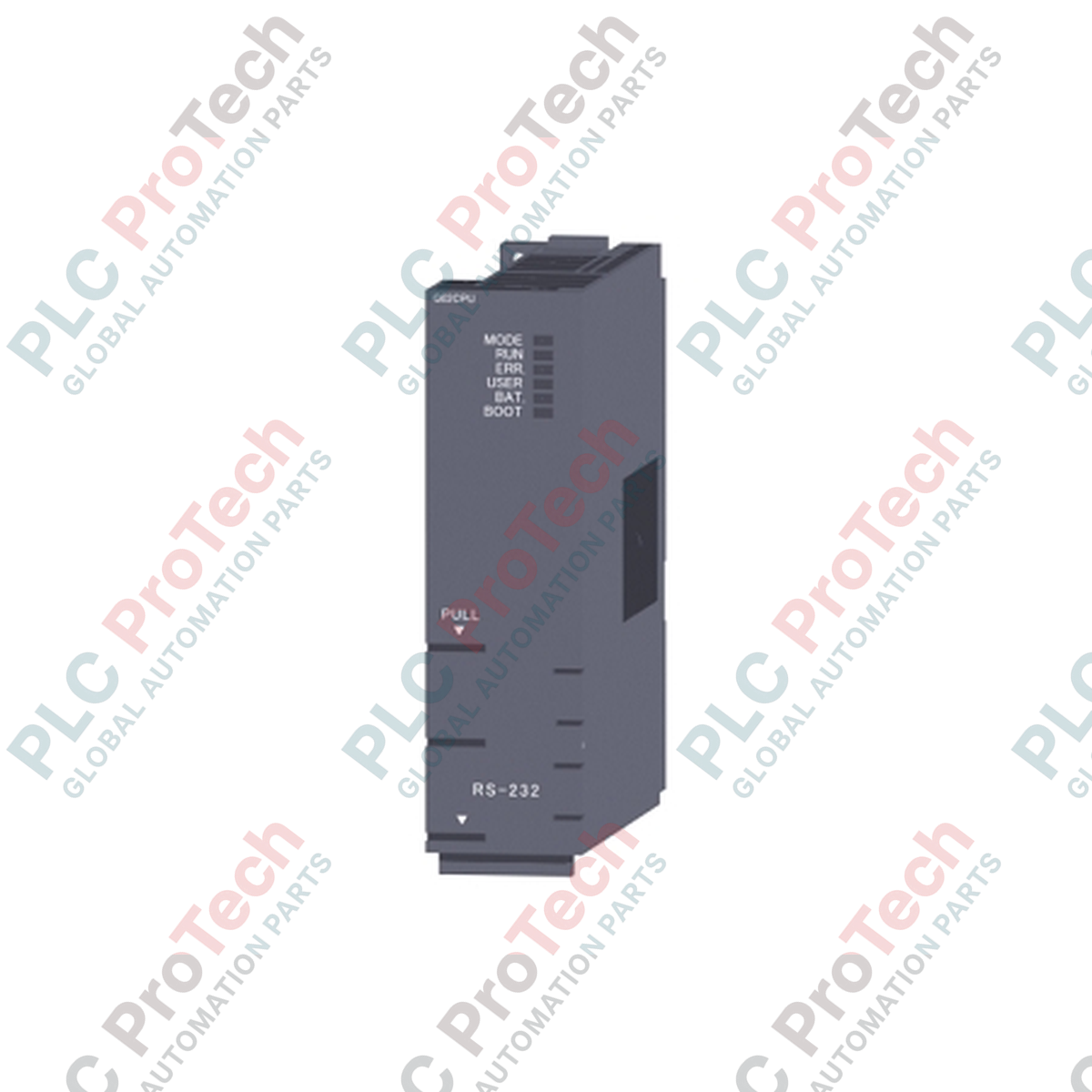
Description
Conçu pour le contrôle centralisé dans les architectures d’automatisation de moyenne envergure, le Mitsubishi Electric Q02CPU agit comme un processeur d’automate programmable haute performance au sein de la famille MELSEC Q Series. Ce module coordonne le contrôle des séquences et le traitement des données des dispositifs grâce à un jeu d’instructions optimisé, garantissant un fonctionnement hautement stable sur les lignes de production. Doté d’un encombrement modulaire compact, il s’intègre directement aux unités de base Q Series standard, permettant une extension et une communication fluides avec des modules d’E/S et de réseau spécialisés.
Fonctionnalités
-
Traitement haute vitesse : Vitesse de traitement des instructions de base de 0,079 µs (microseconde) par instruction LD pour une exécution rapide des programmes.
-
Mémoire programme optimisée : Capacité de programme de 28 k étapes avec 112 Ko de mémoire programme interne.
-
Vastes capacités d’E/S : Prend en charge jusqu’à 4096 points d’E/S locaux et distants, ainsi que 8192 points de dispositifs directs.
-
Options de stockage flexibles : Emplacement intégré pour cartes mémoire (SRAM, Flash ou ATA), permettant de gérer facilement les données de recettes, la journalisation et les sauvegardes de programmes.
-
Communication intégrée : Interface RS-232 intégrée pour une connexion directe aux PC de programmation, aux IHM et aux appareils série.
Applications
-
Lignes d’assemblage automatisées : Assure le contrôle coordonné des séquences pour les systèmes d’assemblage à plusieurs stations.
-
Systèmes de manutention : Gère des réseaux complexes de convoyeurs, des trieurs et des systèmes de transfert.
-
Emballage et transformation alimentaire : Pilote des lignes d’emballage nécessitant un traitement rapide des signaux des capteurs et des sorties précises des actionneurs.
-
Traitement de l’eau et des eaux usées : Sert d’automate programmable central pour les stations de pompage locales et les systèmes de filtration.
Spécifications techniques
| Paramètre |
Valeur |
| Fabricant |
Mitsubishi Electric |
| Numéro de modèle |
Q02CPU |
| Série |
Série MELSEC Q |
| Capacité du programme |
28 k étapes |
| Mémoire programme |
112 Ko |
| Vitesse d’exécution des instructions LD |
0,079 µs |
| Points d’E/S |
4096 points (locaux/distants) |
| Points des dispositifs d’E/S |
8192 points |
| Consommation de courant interne (5 V CC) |
0,60 A |
| Plage de températures de fonctionnement |
0 à 55 °C |
| Poids d’expédition (calculé) |
0,30 kg |
| Dimensions de l’emballage (calculées) |
120 mm x 110 mm x 45 mm |
Connexions et interfaces
| Connecteur / port |
Type d’interface |
Affectation des fonctions |
| Port série intégré |
RS-232 (Mini-DIN à 6 broches) |
Programmation, débogage et connexion directe à l’IHM |
| Interface de carte mémoire |
Emplacement compatible PCMCIA |
Installation d’une carte mémoire externe (SRAM/Flash/ATA) |
Constats techniques empiriques
Modèles alternatifs et compatibilité
Le Q02CPU est un modèle standard ancien de la série MELSEC Q. Pour les systèmes nécessitant une vitesse de traitement supérieure, une connectivité Ethernet intégrée ou des capacités étendues de journalisation des données, envisagez le Q03UDVCPU ou le Q04UDVCPU. Lors du remplacement par un CPU de la série Q Universal, vérifiez les paramètres du programme dans GX Works2, car certains comportements d’instructions spécialisées et formats de cartes mémoire diffèrent entre le Q02CPU classique et les modules « Universal » (UD/UDV) plus récents.
Pièges applicatifs et remarques techniques
Le Q02CPU a une limite stricte de programme de 28 k étapes. Le dépassement de cette limite entraînera des échecs de compilation. Lors de l’utilisation d’un grand nombre de registres de fichiers (ZR), veillez à allouer correctement les blocs mémoire dans les paramètres de l’automate avant le téléchargement. Si la tension de la batterie baisse, les données verrouillées et le contenu de la SRAM stockés seront perdus ; établissez toujours un calendrier périodique de maintenance préventive pour remplacer la batterie de secours Q6BAT.
Conseils de mise en service et de câblage
Lors de la connexion au port RS-232 avec un câble de programmation QC30R2 ou des convertisseurs série-USB tiers, assurez-vous que les paramètres de communication dans GX Works2/GX Developer correspondent (débit en bauds, parité, bits d’arrêt). Pour éviter les interruptions de communication série causées par les interférences électromagnétiques (EMI) haute fréquence provenant de variateurs de fréquence voisins (VFD), assurez-vous que la borne de terre fonctionnelle (FG) de l’unité de base est directement reliée à un point de terre à faible impédance.
Directives d’installation
AVERTISSEMENT CRITIQUE :
Isolez et verrouillez complètement l’alimentation secteur principale qui alimente l’unité de base MELSEC Q avant de monter ou de retirer le module CPU. Le remplacement à chaud du module CPU est strictement interdit et entraînera des dommages matériels irréversibles ou un comportement imprévisible du système.
1
Alignez le crochet inférieur du Q02CPU avec le trou de guidage de l’unité de base principale (par exemple, Q33B, Q35B, Q38B).
2
Enfoncez fermement le module contre le connecteur de l’unité de base, en veillant à ce qu’il n’y ait aucun espace.
3
Fixez le module en serrant la vis de retenue supérieure (couple de serrage de 0,36 à 0,48 N-m) afin d’éviter toute déconnexion due aux vibrations.
4
Branchez le câble de programmation ou de communication au port RS-232 intégré, en assurant un soulagement de traction adéquat.