Description
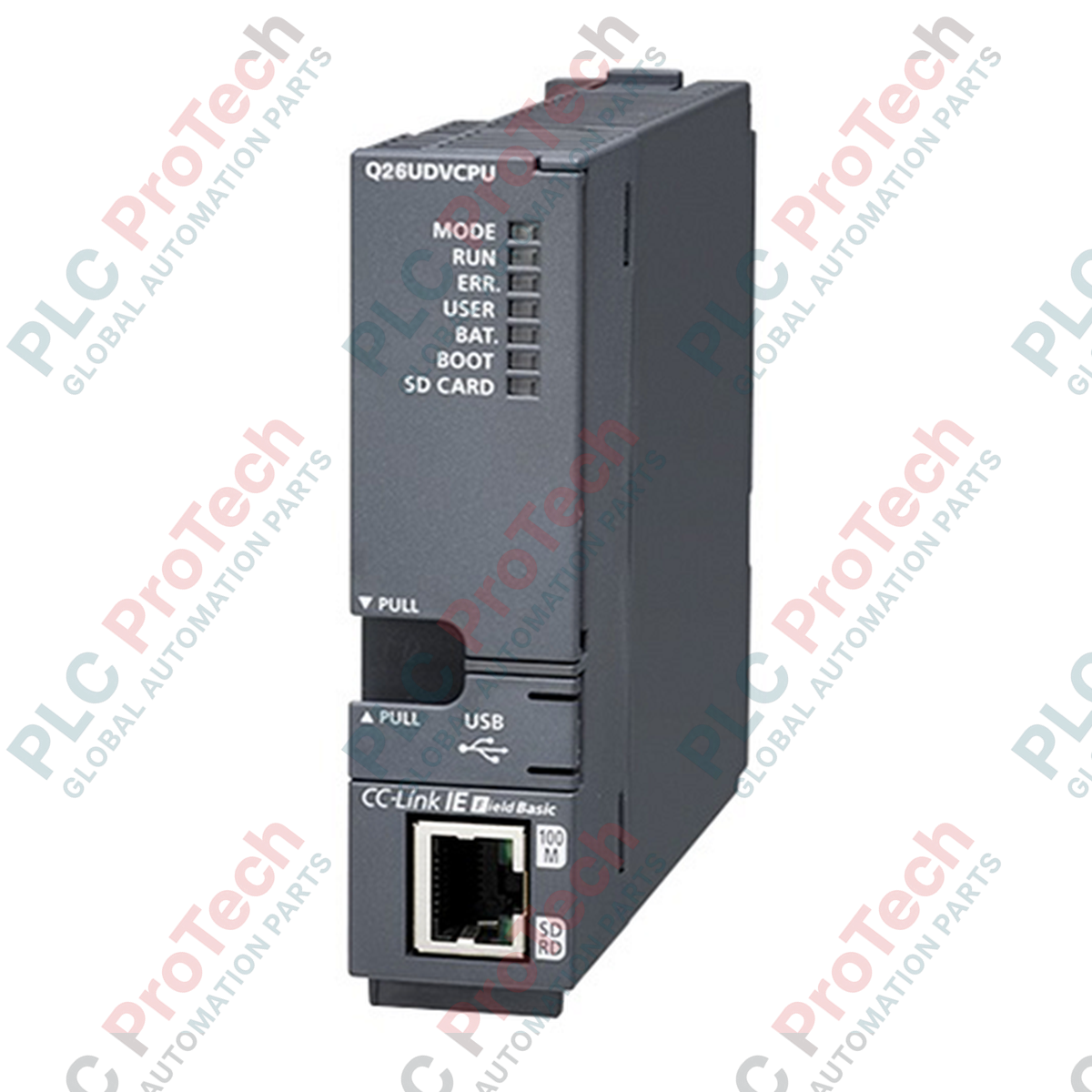
Conçu pour l’exécution rapide de séquences et l’intégration fluide aux réseaux d’usine, le Mitsubishi Electric Q03UDVCPU sert d’unité centrale haute performance au sein de la plateforme d’automatisation MELSEC Q Series. Ce processeur universel haute vitesse répond aux exigences strictes des systèmes de fabrication complexes, avec une vitesse d’exécution ultra-rapide de 1,9 ns pour les opérations LD de base. Grâce à son port Ethernet RJ45 intégré, le module permet une communication robuste au niveau des appareils, la télémétrie de diagnostic et l’accès à la programmation sans nécessiter d’interfaces réseau dédiées. Son architecture prend en charge une capacité de programme substantielle de 30K étapes, ainsi qu’une évolutivité via deux emplacements au moyen de cartes SD/SDHC standard, ce qui en fait un choix idéal pour la journalisation intensive des données et la coordination du contrôle de mouvement de précision dans les architectures industrielles modernes.
Caractéristiques
-
Traitement ultra-haute vitesse : Atteint un temps d’exécution de 1,9 ns pour les instructions LD de base et de 3,9 ns pour les instructions MOV afin de réduire au minimum les temps de scrutation du contrôleur.
-
Interface Ethernet intégrée : Le port RJ45 10/100 Mbit/s intégré prend en charge jusqu’à 16 connexions socket simultanées, le protocole MC et les connexions MELSOFT.
-
Architecture mémoire flexible : Offre une capacité de programme de 120 Ko et 192 Ko de RAM standard, extensible au moyen de cassettes SRAM étendues.
-
Prise en charge SD/SDHC intégrée : L’emplacement pour carte intégré prend en charge les supports de stockage standard jusqu’à 32 Go pour la journalisation sécurisée des données, la gestion des recettes et les sauvegardes automatisées du système.
-
Programmation multilingue : Entièrement compatible avec le texte structuré (ST), les blocs fonctionnels, SFC (MELSAP 3) et la logique à relais traditionnelle.
Applications
- Systèmes d’emballage synchronisés multiaxes à grande vitesse.
- Suivi des lignes d’assemblage automobile et cellules de manutention des composants.
- Infrastructures de traitement de l’eau distribuées utilisant des systèmes de télémétrie.
- Machines de traitement thermique et d’indexation de semi-conducteurs de haute précision.
Spécifications techniques
| Paramètre |
Valeur de spécification |
| Fabricant |
Mitsubishi Electric |
| Code modèle |
Q03UDVCPU |
| Méthode de contrôle |
Opération d’itération du programme enregistré |
| Capacité du programme |
30K étapes (120 Ko) |
| Vitesse d’exécution des instructions LD |
1,9 ns |
| Points d’E/S physiques |
4096 points |
| RAM / ROM standard |
192 Ko / 1025,5 Ko |
| Consommation de courant interne (5 V CC) |
0,58 A (unité de base) / 0,60 A (avec cassette SRAM) |
| Stockage pris en charge |
Carte mémoire SD/SDHC (jusqu’à 32 Go) |
| Ports intégrés |
Ethernet RJ45, mini-USB, emplacement pour carte SD |
| Température ambiante de fonctionnement |
0 à 55 °C |
| Poids net |
0,20 kg |
| Dimensions (L x H x P) |
27,4 mm x 98 mm x 115 mm |
| Poids d’expédition (calculé) |
1,20 kg |
Observations techniques empiriques
Modèles alternatifs et compatibilité
Le Q03UDVCPU représente l’évolution universelle haute vitesse de l’ancien Q03UDECPU. Lors de la mise à niveau de systèmes existants, notez que la série V utilise un emplacement intégré pour carte SD/SDHC au lieu des anciennes options de carte CompactFlash ou PCMCIA. Pour garantir la compilation correcte de la logique système et de l’affectation des tâches, votre équipe d’ingénierie doit mettre à jour le type d’automate cible vers « Q03UDV » dans GX Works2 (version 1.98C ou ultérieure) ou GX Works3 avant d’effectuer un téléchargement du code.
Pièges liés à l’application et remarques techniques
Bien que la mémoire du programme soit non volatile, la conservation des paramètres verrouillés, des registres (D, W) et des données de l’horloge système interne dépend de la pile lithium de secours Q6BAT. Dans les environnements où la température ambiante de fonctionnement dépasse constamment 45 °C, la courbe de dégradation de la pile s’accélère. Il est fortement recommandé de surveiller le registre spécial SD8005 (indicateur de batterie faible) via votre système SCADA ou votre IHM locale afin de planifier la maintenance préventive avant toute perte de données.
Conseils de mise en service et de câblage
Pour garantir une connectivité Ethernet fiable, utilisez un câblage industriel RJ45 blindé (S/FTP) et éloignez-le des câbles de sortie d’onduleurs haute tension. Lors de la configuration des paramètres Ethernet intégrés dans votre suite de programmation GX, vérifiez attentivement que la plage d’adresses IP n’entre pas en conflit avec les routes IP actives sur le réseau de votre entreprise. En outre, connectez toujours directement la borne de terre fonctionnelle (FG) de l’unité de base à une prise de terre à faible impédance afin de la protéger contre les bruits de commutation transitoires haute fréquence.
Consignes d’installation
AVERTISSEMENT DE SÉCURITÉ CRITIQUE
Isolez toujours toutes les alimentations électriques principales qui alimentent l’ensemble du fond de panier (telles que les unités de base principales Q38B ou Q312B) avant d’insérer ou de retirer le module Q03UDVCPU. Toute tentative de remplacement à chaud ou toute manipulation de l’unité centrale lorsque le bloc d’alimentation est actif endommagera immédiatement l’interface du bus du fond de panier et peut entraîner la défaillance des modules d’E/S voisins.
1
Assurez-vous que le module d’alimentation principal installé sur l’unité de base est complètement hors tension et vérifiez-le à l’aide d’un voltmètre étalonné.
2
Alignez le crochet inférieur du Q03UDVCPU avec l’orifice de guidage du module situé à l’emplacement 0 de l’unité de base de la série MELSEC Q.
3
Poussez fermement le haut du module vers le fond de panier jusqu’à ce que le loquet supérieur s’enclenche correctement, puis serrez la vis de fixation du module (M3) à un couple de 0,36 à 0,48 N-m.
4
Insérez la carte SD si nécessaire, vérifiez que le verrouillage de la carte mémoire est activé et branchez votre câble de communication RJ45 blindé au port Ethernet intégré avant de rétablir l’alimentation de commande.