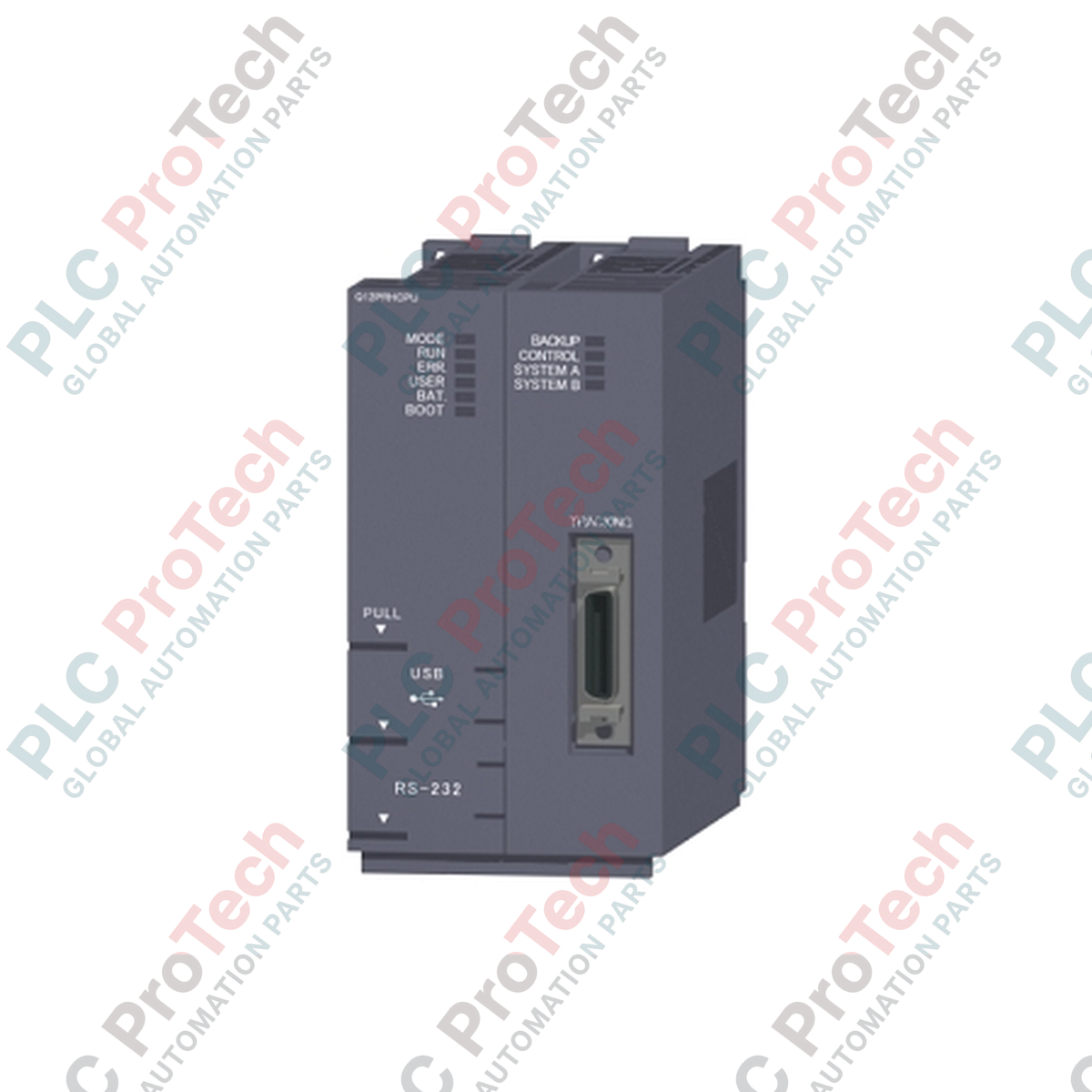
Conçu pour assurer un contrôle à haute disponibilité dans des environnements d'automatisation critiques, le Mitsubishi Electric Q12PRHCPU fonctionne comme un module CPU redondant haute performance au sein de la plateforme MELSEC Q Series. Ce module est conçu pour éviter les temps d'arrêt système grâce à une architecture double redondance où un CPU de secours prend instantanément le contrôle en cas de défaillance du CPU principal. Il dispose d'une capacité de programme de 120k étapes et supporte jusqu'à 4096 points d'E/S physiques, ce qui le rend adapté aux opérations industrielles à grande échelle et tolérantes aux pannes.
Caractéristiques clés
-
Architecture système redondante : Prend en charge la redondance en veille chaude avec basculement automatique sans à-coup pour éviter toute interruption de processus.
-
Traitement haute vitesse : Exécute les instructions LD en 34 nanosecondes (0,034 microsecondes) pour une exécution rapide des tâches.
-
Capacité de remplacement à chaud : Permet le remplacement en ligne des modules CPU de secours, alimentation et réseau sans interrompre le processus de contrôle actif.
-
Interfaces de programmation doubles : Équipé de ports USB (Mini-B) et RS-232 (Mini-DIN) pour une programmation, un diagnostic et une surveillance flexibles.
-
Capacité mémoire étendue : Offre 120k étapes de mémoire programme avec une mémoire de suivi dédiée pour une synchronisation fluide des données entre unités actives et de secours.
Applications
- Traitement de l'eau et usines municipales de traitement des eaux usées.
- Lignes continues de traitement chimique, pétrochimique et pharmaceutique.
- Production d'énergie, automatisation des postes électriques et réseaux de distribution des services publics.
- Ventilation de tunnel, systèmes d'alimentation des transports publics et infrastructures critiques.
Spécifications techniques
| Paramètre |
Valeur de spécification |
| Fabricant |
Mitsubishi Electric |
| Numéro de modèle |
Q12PRHCPU |
| Série |
Série MELSEC Q |
| Type de module |
Module CPU PLC redondant |
| Capacité du programme |
120k étapes (480 Ko) |
| Points E/S (physiques) |
4096 points |
| Points E/S (appareil) |
8192 points |
| Vitesse d'instruction LD |
0,034 microsecondes (34 ns) |
| Consommation de courant (5 VCC) |
0,89 A |
| Température de fonctionnement |
0 à 55 °C |
| Température de stockage |
-25 à 75 °C |
| Humidité relative |
5 à 95 % HR (sans condensation) |
| Poids net |
0,30 kg |
| Poids d'expédition (calculé) |
2,00 kg |
| Dimensions (L x H x P) |
27,4 mm x 98 mm x 115 mm |
| Pays d'origine |
Japon |
Connexions et interfaces
| Port d'interface |
Type de connecteur |
Affectation fonctionnelle |
| Port RS-232 |
Mini-DIN 6 broches |
Programmation série, connexion périphérique et diagnostics système. |
| Port USB |
Mini-B |
Programmation, surveillance et configuration des paramètres à haute vitesse via GX Works2. |
| Port de suivi |
Connecteur redondant dédié |
Connexion de câble de suivi haute vitesse pour synchroniser la mémoire avec le CPU de secours. |
Aperçus empiriques d'ingénierie
Modèles alternatifs et compatibilité
Le Q12PRHCPU doit être utilisé avec des unités de base redondantes (comme le Q38RB ou Q68RB) et des modules d'alimentation redondants (Q61P-D). Il ne peut pas être mélangé avec des CPU standard de la série Q sur une unité de base standard pour des opérations redondantes. Lors du remplacement d'anciens modules Q12HCPU, notez que les unités de base standard non redondantes sont incompatibles avec l'interface physique de suivi et le routage double bus de la série redondante.
Pièges d'application et notes d'ingénierie
La longueur du câble de suivi est une contrainte critique. Les câbles de suivi standard (QC10TR ou QC30TR) sont limités à 3 mètres. Dépasser cette distance ou utiliser des câbles personnalisés non blindés peut introduire des interférences électromagnétiques, entraînant des échecs de synchronisation du suivi (tels que « SP.UNIT LAY. ERR » ou « CONTROL CPU ERROR »). De plus, optimisez les paramètres de taille des données de suivi dans GX Works2 pour éviter des extensions excessives du temps de balayage lors des cycles de synchronisation.
Conseils de mise en service et de câblage
Avant de mettre sous tension le système redondant, vérifiez que les modules CPU principal (Système A) et de secours (Système B) ont des versions de firmware identiques. Les différences de firmware peuvent empêcher le CPU de secours d'entrer en état « BACKUP », laissant le système en mode mono-CPU non redondant. Téléchargez toujours des fichiers de paramètres et des blocs de programme identiques sur les deux unités avant d'exécuter la synchronisation initiale du système.
Directives d'installation
AVERTISSEMENT CRITIQUE :
Assurez-vous que toutes les sources d'alimentation externes alimentant l'unité de base et les racks E/S associés sont complètement hors tension avant de monter ou de retirer les modules CPU. Le non isolement de l'alimentation peut entraîner des arcs électriques, des dommages au bus interne du backplane ou des changements inattendus d'état du système de contrôle.
1
Montez solidement le module CPU sur l'unité de base redondante (Q38RB ou Q68RB), en vous assurant que la languette de verrouillage inférieure s'enclenche fermement.
2
Connectez le câble de suivi dédié entre les ports de suivi des deux modules Q12PRHCPU pour établir le lien de synchronisation.
3
Fixez les connecteurs du câble de suivi à l'aide des vis de retenue intégrées pour éviter toute déconnexion accidentelle due aux vibrations du panneau.
4
Établissez une connexion de terre fonctionnelle solide depuis les bornes LG et FG de l'unité de base jusqu'au bus de terre principal de l'armoire de contrôle.