1 of 1

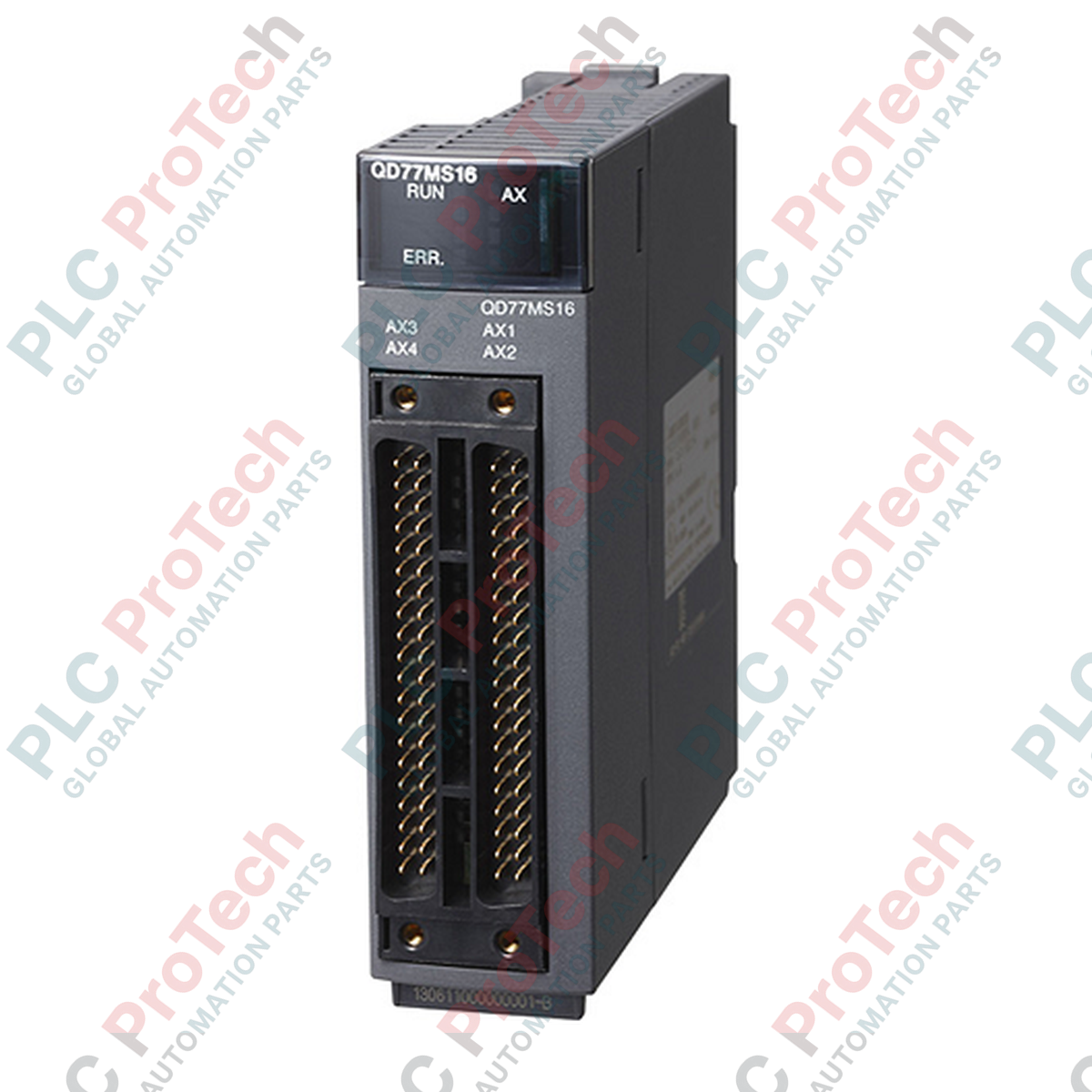
QD77MS16 | Mitsubishi Electric | Module de mouvement simple

QD77MS16 | Mitsubishi Electric | Module de mouvement simple

Il ne reste que 10 article(s) en stock
  • Fabricant : Mitsubishi Electric

  • N° de produit : QD77MS16

  • Pays d'origine :États-Unis

  • Type de produit : Module de mouvement simple

  • Paiement : Virement bancaire, Western Union

  • Poids : 500g

  • Port d'expédition : Xiamen

  • Garantie : 12 mois

Quantité
Voir les détails complets

Description

Designed for high-performance positioning and multi-axis synchronization within the MELSEC-Q platform, the QD77MS16 Simple Motion Module delivers advanced motion control capabilities over the high-speed optical SSCNET III/H network. This module streamlines complex motion applications by integrating positioning control, synchronous control, and electronic cam functionality into a single slot design. By leveraging fiber-optic communication, the QD77MS16 ensures noise-immune, high-speed data transmission between the controller and servo amplifiers, making it highly reliable for demanding industrial automation setups.

The module supports synchronous operations such as electronic gears, clutches, and cams without requiring complex programming, relying instead on parameter-based configurations in GX Works2. It manages 2-, 3-, or 4-axis linear interpolation and 2-axis circular interpolation, enabling smooth trajectory execution for complex mechanical systems. It functions as an ideal interface for high-precision machinery requiring multi-axis coordination and centralized diagnostic monitoring.

Features

  • Controls up to 16 physical axes via high-speed SSCNET III/H optical fiber network.
  • Supports multi-axis interpolation including 2-, 3-, or 4-axis linear and 2-axis circular interpolation.
  • Flexible coordinate systems and control units including millimeters, inches, degrees, and pulses.
  • Stores up to 600 positioning data entries per axis for standalone trajectory storage.
  • Provides advanced synchronous control features including electronic cam, electronic clutch, and electronic gear.
  • Noise-immune fiber optic communication ensures reliable operation in high electromagnetic interference (EMI) environments.

Applications

  • Packaging machinery and bottling lines requiring continuous-path synchronization.
  • Material handling systems, gantries, and automated storage/retrieval systems (ASRS).
  • High-speed pick-and-place systems and assembly lines.
  • Semiconductor fabrication and wafer handling systems.
  • Metalforming, cutting, and textile winding applications.

Technical Specifications

Parameter Specification
Manufacturer Mitsubishi Electric
Part Number/Model QD77MS16
Series MELSEC-Q Series
Module Type Simple Motion Module
Number of Control Axes 16 axes
Servo Network Connection SSCNET III/H (Optical communication)
Communication Cycle 0.88 ms or 1.77 ms (depending on configured axis limit)
Interpolation Capabilities 2-, 3-, or 4-axis linear interpolation, 2-axis circular interpolation
Control Method PTP (Point-to-Point) control, CP (Continuous Path) control, Speed-Position switching, Position-Speed switching
Control Units mm, inch, degree, pulse (PLS)
Positioning Data Capacity 600 points per axis
Internal Current Consumption 0.75 A (at 5V DC)
Backplane Slot Width Single slot on MELSEC-Q base unit

Connections and Interfaces

Interface Port Function Description
SSCNET III/H (CN1) Optical connector for connection to downstream servo amplifiers (MR-J4/MR-J3 series).
External Input Connector For manual pulse generator, external inputs (FLS, RLS, DOG, STOP, EMI), and high-speed touch probes.

Installation Guidelines

  • Mounting: Ensure the system power is completely isolated before inserting or removing the module from the MELSEC-Q base unit. Securely tighten the module installation screws.
  • SSCNET III/H Fiber Optic Cabling: Always respect the minimum bending radius of the optical fiber cables (typically 25 mm to 30 mm depending on cable type) to avoid attenuation or physical damage.
  • Grounding: Ensure the Q-series rack base unit is connected to a dedicated functional ground (Class D grounding, 100 ohms or less) using a heavy gauge wire.
  • Shielding: Shield all external input/output cables and ground the shields near the module entry point to minimize noise coupling.

Compliance and Certifications

  • CE (EMC Directive)
  • UL / cUL Listed
  • KC (Korea Certification)
Loading product navigation…

What network protocol does the QD77MS16 use to communicate with servo drives?

The QD77MS16 uses the high-speed fiber-optic SSCNET III/H network protocol to communicate with compatible servo drives, such as the MR-J4 series.

How many axes of control does the QD77MS16 simple motion module support?

The QD77MS16 supports control for up to 16 axes.

Which software is used to configure and program the QD77MS16?

The module is configured using the Simple Motion Module Setting Tool, which is integrated directly into MELSOFT GX Works2 software.

What types of interpolation are supported by this module?

It supports 2-, 3-, or 4-axis linear interpolation as well as 2-axis circular interpolation.

What is the 5V DC internal current consumption of the QD77MS16?

The internal current consumption of the module on the Q-series backplane is 0.75 A at 5V DC.

Expédition express mondiale

  • Livraison standard : 4 à 6 jours ouvrables via DHL, FedEx et UPS.
  • Expédition express : Expédition le jour même pour les commandes en stock passées avant 14h00 (GMT+8).
  • Couverture mondiale : Service dans plus de 150 pays, avec livraison rapide en Arabie Saoudite et aux Émirats arabes unis.

Retours et garantie

  • Garantie de 30 jours : Retours acceptés pour les produits en stock dans leur emballage d'origine scellé en usine.
  • Garantie de 12 mois : Chaque composant industriel est couvert par notre garantie technique professionnelle.

Les commandes sont traitées et livrées du lundi au vendredi (hors jours fériés).


Pour connaître l'éligibilité complète, les frais de restockage et les détails des retours internationaux, veuillez consulter notre site officiel Politique de remboursement et de retour .

TECHNICAL SPECIFICATIONS

Country of origin
États-Unis

Produits récemment consultés

Connaissances techniques

Actionneurs électriques conçus pour remplacer les systèmes à fluide : un guide pratique d'automatisation industrielle

Cet article explique comment les actionneurs électriques intégrés, tels que la série e-Actuator de SMC, transforment le contrôle du mouvement industriel en remplaçant les systèmes pneumatiques et...

Opérations mathématiques avec OpenPLC pour les applications d'automatisation industrielle

Cet article explique comment les systèmes PLC réalisent des opérations mathématiques de base telles que l'addition, la soustraction, la multiplication, la division, le modulo et l'exponentiation dans...

Logique booléenne avancée avec la programmation FBD PLC : applications industrielles pratiques au-delà de la logique de base

L'article explique plusieurs fonctions avancées de la logique booléenne utilisées en programmation d'automates programmables industriels (API) au-delà des opérations de base ET, OU et NON. Il aborde...

Logique booléenne en programmation PLC : comprendre les portes logiques FBD

La logique booléenne est la base de tout programme PLC. Des commandes machines simples aux systèmes d'automatisation industrielle complexes, les portes logiques déterminent comment les contrôleurs...

Guide approfondi sur les pare-feux industriels et la segmentation des réseaux OT

Les pare-feux industriels jouent un rôle crucial dans la cybersécurité OT, protégeant les réseaux PLC, DCS et SCADA grâce à la segmentation, au contrôle des entrées/sorties et à l’intégration IDS/IPS...

Guide des pinces robotiques : de la manipulation délicate à l'automatisation lourde

Les pinces robotiques modernes évoluent au-delà des mâchoires mécaniques traditionnelles. Des systèmes adhésifs inspirés des geckos aux pinces souples de qualité alimentaire, en passant par des...