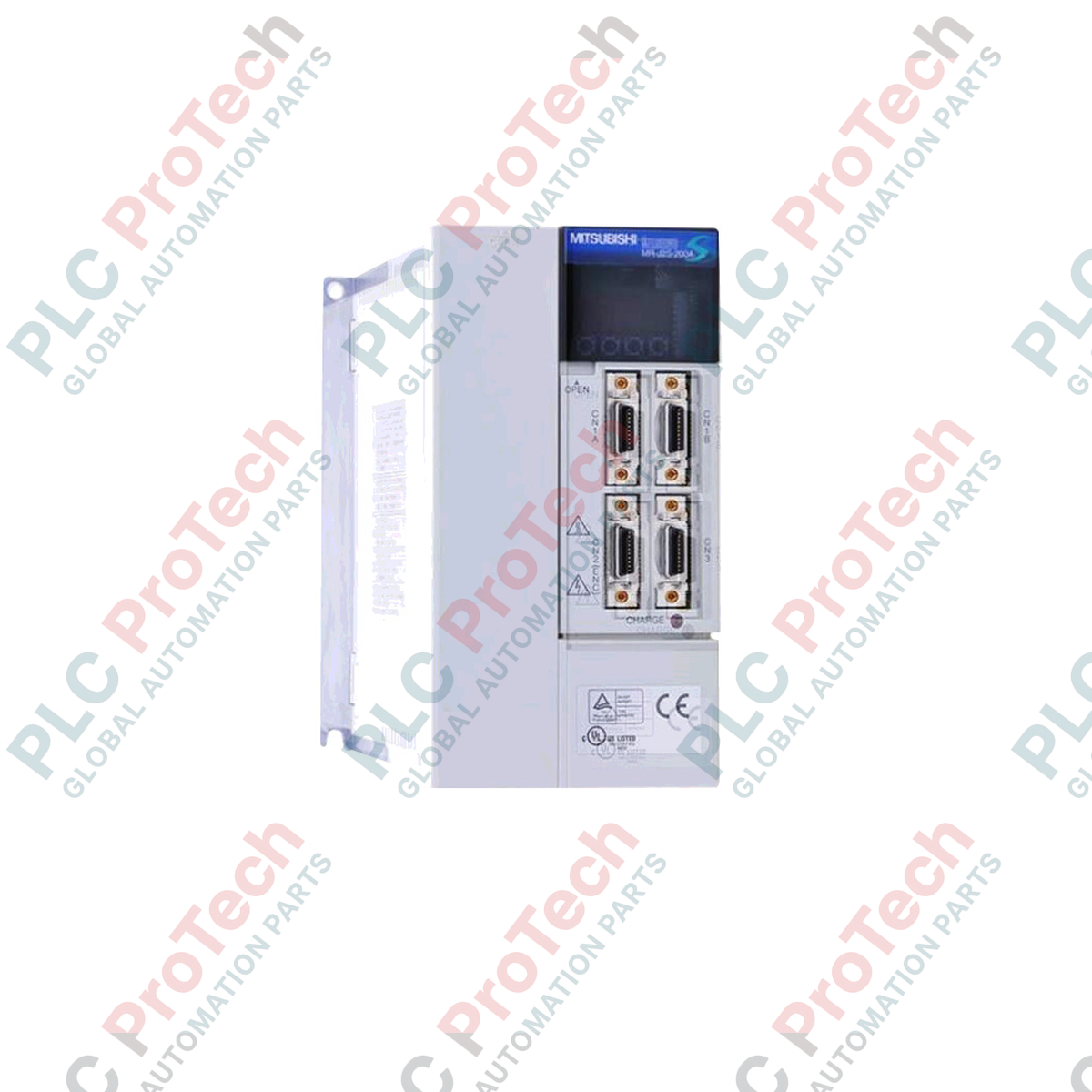
Description
S’intégrant parfaitement aux réseaux de mouvement industriels de haute précision, ce variateur dynamique Mitsubishi Electric MR-JS2-200A offre un contrôle précis en boucle fermée de la vitesse, du couple et de la position pour les servomoteurs rotatifs CA compatibles. Doté d’une interface analogique et à train d’impulsions, cet amplificateur servo de 2,0 kW est optimisé pour les tâches de positionnement à réponse rapide dans les systèmes d’automatisation robustes. Il utilise des algorithmes avancés de réglage adaptatif en temps réel pour réduire les erreurs de suivi au minimum et gérer les variations de charge mécanique sans intervention manuelle.
Caractéristiques
-
Interface polyvalente (type A) : prend en charge les commandes standard par train d’impulsions et les commandes d’entrée analogique pour une intégration universelle avec des automates programmables et des contrôleurs de mouvement externes.
-
Suppression dynamique des vibrations : réduit au minimum la résonance mécanique et les vibrations haute fréquence pendant les phases de décélération à grande vitesse.
-
Autoréglage en temps réel : calcule et ajuste automatiquement les gains optimaux de la boucle de commande en fonction des variations de l’inertie de la charge.
-
Encombrement réduit : conçu pour un montage côte à côte peu encombrant dans les armoires de commande industrielles.
Applications
- Machines d’assemblage pick-and-place à grande vitesse et portiques cartésiens.
- Systèmes d’usinage CNC multiaxes, de fraisage et de détourage.
- Machines automatisées d’emballage, de mise en carton et d’étiquetage.
- Systèmes de manipulation de plaquettes pour la fabrication de semi-conducteurs.
Spécifications techniques
| Spécification technique |
Valeur |
| Fabricant |
Mitsubishi Electric |
| Référence du modèle |
MR-JS2-200A |
| Type d’interface de commande |
Type A (analogique polyvalent / train d’impulsions) |
| Puissance nominale de sortie |
2,0 kW (2 000 watts) |
| Phase de la tension d’entrée |
CA triphasé |
| Tension nominale d’entrée |
200 à 230 V CA |
| Courant nominal d’entrée |
10,5 A |
| Plage de fréquences d’entrée |
50 / 60 Hz |
| Température ambiante de fonctionnement |
0 à 55 °C (sans gel) |
| Poids d’expédition (calculé) |
5,0 kg |
| Pays d’origine |
Japon |
Connexions et interfaces
| Bloc de bornes / connecteurs |
Affectation et fonction du circuit |
| L1, L2, L3 |
Entrée d’alimentation principale CA (triphasé 200-230 V CA) |
| U, V, W |
Sortie d’alimentation du servomoteur (CA triphasé à fréquence variable) |
| P, D, C |
Bornes pour résistance de régénération (P-D court-circuitées pour la résistance interne) |
| CN1A / CN1B |
Commandes analogiques, entrée de commande par train d’impulsions et signaux d’E/S numériques |
| CN2 |
Connexion de retour du codeur (communications série) |
Modèles alternatifs et compatibilité
Cet amplificateur appartient à la gamme d’interfaces universelles classiques. Si vous convertissez des systèmes utilisant une commande réseau SSCNET (type B), veillez à effectuer les modifications de la source de commande dans le logiciel de votre API. Pour remplacer des variateurs de la série MR-J2S-200A plus anciens, vérifiez que les surfaces de montage et les terminaisons des câbles sont propres et sèches, car les configurations des broches des connecteurs restent largement compatibles, mais l’espacement des bornes peut différer légèrement selon certaines versions du boîtier.
Pièges d’application et remarques techniques
L’utilisation de charges à forte inertie à des cadences rapides peut dépasser la capacité de freinage régénératif interne de l’amplificateur. Surveillez attentivement les paramètres de diagnostic afin de détecter les défauts AL.30 (erreur de régénération) ou AL.33 (surtension). Si ces défauts se déclenchent, débranchez la liaison entre les bornes P et D et raccordez un dispositif de freinage régénératif externe correctement dimensionné entre P et C. Veillez à maintenir un espace thermique de 40 mm au-dessus et au-dessous du variateur dans les armoires électriques non ventilées.
Conseils de mise en service et de câblage
Acheminez toujours les lignes haute tension (L1/L2/L3 et U/V/W) dans des goulottes séparées des lignes de signaux basse tension (CN1A/CN1B et CN2) afin de réduire le couplage électromagnétique. Utilisez toujours des câbles blindés à paires torsadées tressées pour les fils de signaux du codeur et raccordez directement le blindage à la coque du connecteur CN2. Reliez le châssis de l’amplificateur à la terre à l’aide d’une tresse en cuivre à faible impédance, vers une plaque de terre système en point unique.
Directives d’installation
AVERTISSEMENT CRITIQUE
Assurez-vous que toute l’alimentation secteur CA d’entrée est complètement déconnectée et consignée avant toute modification des bornes. Après la mise hors tension, attendez au moins 15 minutes afin que les condensateurs internes du bus CC haute tension se déchargent jusqu’à un niveau sûr (inférieur à 20 V) avant de procéder au câblage ou aux inspections internes.
1
Montez l’amplificateur verticalement sur des panneaux en tôle plats et rigides, en veillant à ne pas obstruer les voies de ventilation.
2
Fixez le conducteur de terre (PE) à la borne de terre de protection avant de brancher les câbles d’alimentation ou du moteur.
3
Branchez les connecteurs CN1 de commande haute densité et CN2 de retour du codeur, puis serrez les vis des connecteurs à la main.
4
Appliquez d’abord l’alimentation de commande pour vérifier les réglages des paramètres du variateur à l’aide du logiciel de configuration série avant de mettre sous tension le secteur.