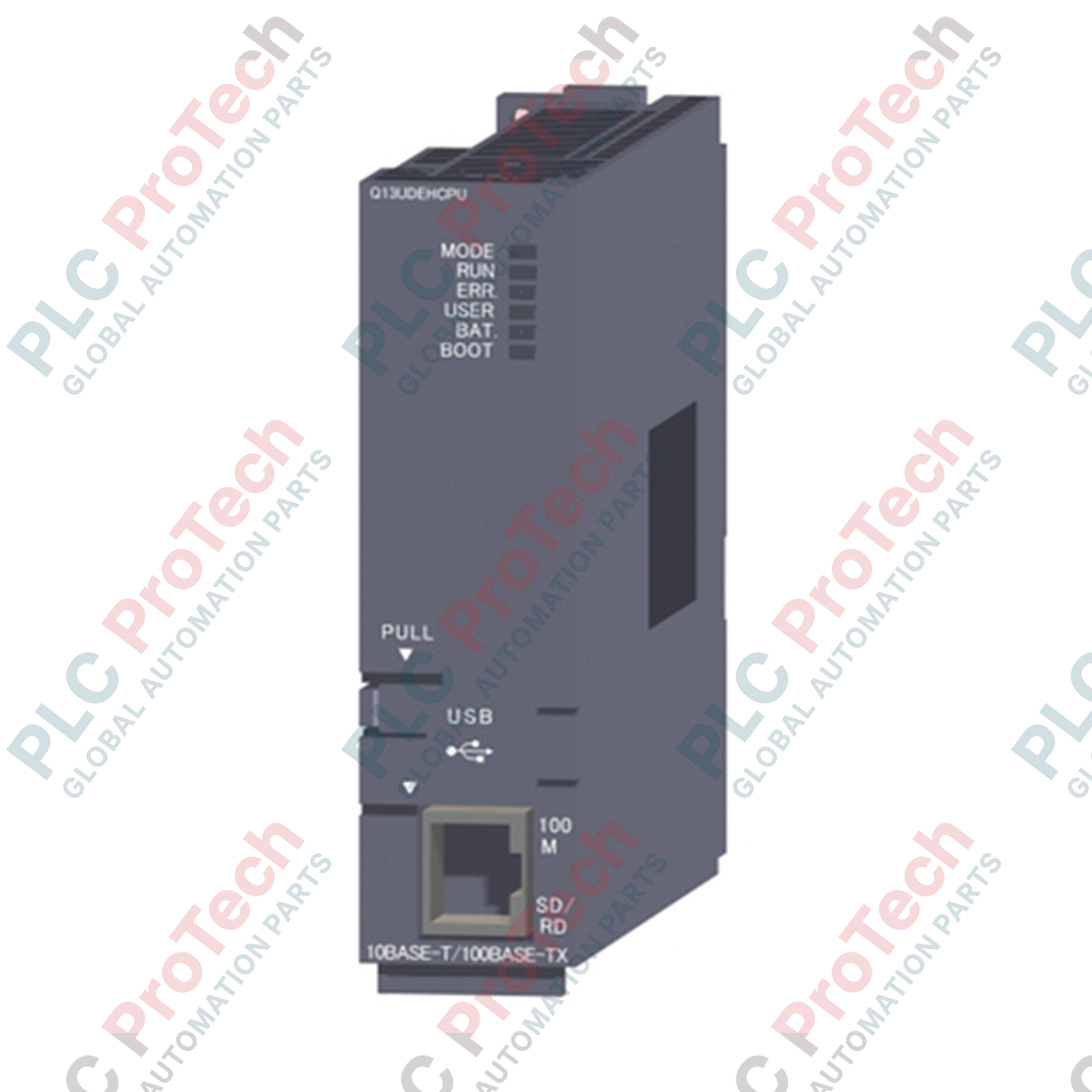
Description
Conçu pour les architectures d’automatisation multiprocesseur haute vitesse, le Mitsubishi Electric Q13UDEHCPU agit comme une unité centrale haute performance au sein de la plateforme MELSEC série Q. Ce modèle universel est doté d’une architecture à double processeur qui réduit considérablement les temps d’exécution des programmes, ce qui le rend adapté aux calculs mathématiques complexes et aux applications industrielles à haute densité. Équipé d’un port Ethernet intégré, le Q13UDEHCPU simplifie l’intégration au réseau en offrant un échange de données pair à pair transparent et une surveillance directe depuis un PC, sans nécessiter de modules de communication supplémentaires.
Fonctionnalités
-
Exécution haute vitesse : traitement ultra-rapide des instructions séquentielles à 9,5 ns pour les opérations LD de base et à 19 ns pour les instructions MOV.
-
Allocation mémoire généreuse : doté d’une capacité de programme de 130 kpas, de 520 Ko de mémoire programme et de 1024 Ko de RAM standard pour les algorithmes de commande complexes.
-
Interface Ethernet intégrée : prend en charge des vitesses de transmission de 100/10 Mbit/s et permet jusqu’à 16 connexions socket simultanées pour les fonctions MC Protocol, MELSOFT et FTP.
-
Registres de fichiers extensibles : jusqu’à 32768 points de registres de fichiers standard, extensibles via des cartes mémoire SRAM ou Flash externes pour gérer de grandes quantités de données de suivi.
-
Architecture multiprocesseur : partage de manière transparente les zones mémoire avec jusqu’à trois processeurs MELSEC série Q associés pour la commande de mouvement ou les tâches de calcul basées sur PC.
Applications
- Synchronisation d’assemblage automobile haute densité et d’ateliers de peinture.
- Manipulation de plaquettes et profilage de température dans la fabrication de semi-conducteurs.
- Systèmes de commande de mouvement coordonné multi-axes et de conditionnement.
- Installations municipales de traitement de l’eau nécessitant des réseaux Ethernet industriels distribués.
Spécifications techniques
| Fabricant |
Mitsubishi Electric |
| Modèle / SKU |
Q13UDEHCPU |
| Série |
MELSEC série Q (modèle universel) |
| Méthode de contrôle |
Opération d’itération du programme enregistré |
| Méthode de contrôle des E/S |
Méthode de rafraîchissement (Accès direct possible via la spécification DX/DY) |
| Capacité du programme |
130 kpas (520 Ko) |
| Vitesse d’exécution des instructions LD |
9,5 ns |
| RAM standard |
1024 Ko (Lecteur 3) |
| ROM standard |
2048 Ko (Lecteur 4) |
| Total des points d’E/S |
4096 points physiques (8192 points pour la représentation totale de l’appareil) |
| Port Ethernet |
10/100 Mbps RJ45 (duplex intégral / semi-duplex) |
| Consommation de courant interne |
0,49 A à 5 VCC |
| Température de fonctionnement |
0 à 55 °C |
| Pays d’origine |
Japon |
| Dimensions (H x L x P) |
98 mm x 27,4 mm x 115 mm |
| Masse nette |
0,22 kg |
| Poids d’expédition (calculé) |
0,45 kg (emballé) |
Observations techniques empiriques
Modèles alternatifs et compatibilité
Le Q13UDEHCPU est une mise à niveau directe des anciens modèles Q12HCPU et Q13HCPU. Toutefois, comme il appartient à la génération Universal QCPU, l’enregistrement de la mémoire, les structures des registres de fichiers et les jeux de paramètres du logiciel de programmation diffèrent. Lors de la conversion des programmes dans GX Works2/3, vérifiez attentivement la configuration de vos registres de fichiers (dispositifs ZR par rapport aux dispositifs R), car le CPU Universal gère les secteurs de RAM standard différemment de l’ancienne série High-Performance.
Pièges liés aux applications et remarques d’ingénierie
Lors de la configuration d’une plateforme mult processeur, calculez la consommation totale de 5 VCC sur l’ensemble de l’unité de base. La combinaison d’un Q13UDEHCPU (0,49 A), d’un CPU de mouvement et de plusieurs modules Ethernet ou de bus de terrain peut facilement dépasser les limites des modules d’alimentation standard. Sélectionnez une alimentation Q61P ou Q62P avec une marge suffisante afin d’éviter les défauts système dus à une basse tension.
Conseils de mise en service et de câblage
Pour éviter les interruptions de communication sur le port Ethernet intégré en présence de fortes interférences électromagnétiques (EMI), utilisez un câblage STP (paire torsadée blindée) de catégorie 5e ou supérieure. Assurez-vous que le blindage est mis à la terre du côté du commutateur. Évitez de faire passer le câble de communication Ethernet parallèlement aux lignes de moteur CA haute tension ou aux câbles de sortie du variateur dans les goulottes de câblage.
Directives d’installation
AVERTISSEMENT CRITIQUE : danger physique
Débranchez toutes les sources d’alimentation externes avant d’installer, de retirer ou de câbler un module sur l’unité de base MELSEC Q. Le fait de ne pas mettre complètement le rack hors tension peut provoquer une décharge électrique, endommager physiquement les broches du processeur CPU ou entraîner un fonctionnement erratique du système.
1
Repérez le logement du CPU sur l’unité de base principale (généralement le logement situé juste à droite du module d’alimentation, désigné comme logement CPU 0).
2
Accrochez la languette d’alignement inférieure du CPU dans le trou de guidage de l’unité de base, en veillant à ce que les broches du connecteur soient parfaitement alignées.
3
Poussez fermement le module vers la plaque de base et fixez-le à l’aide de la vis de verrouillage intégrée située au sommet du module afin d’éviter tout délogement dû aux vibrations.